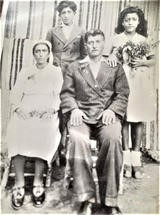
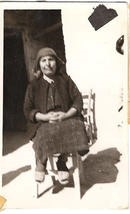
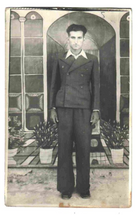
The Riala, Vosko, Kilinciri, Sguri & Sguluga formed part of this family group
Hasan Hüseyin Çoban
The Riala, Vosko, Kilinciri, Sguri & Sguluga formed part of this family group
HASAN HÜSEYİN ÇOBAN ‘TOPAL HASAN’ ‘Gutso Hasano’. [1]
their children
1 Hüseyin Hasan Çoban ‘Vosko’ born 1790-91 Sipahi. [2]
2 İbrahım Hasan Çoban ‘Kudozi’ 1791-2
3 Ramadan Hasan Çoban ‘Silahcı’ born 1820 married Naile Hasan born 1829. They married in 1842
(The 1831 census lists him as being 23 years old. Person No” 82. This would mean he was actually born in 1808. It’s possible he was 13 years old and the translator typed it wrong which would bring him closer to the 1878-9 census records.On the other hand the 1878-79 census made many mistakes as it relied on individuals giving their age, whereas the 1831 census was closer to the period in question. These however are speculative and knowing the facts are difficult.
4 Yusuf Hasan Çoban ‘Skuluga’ born 1806
5 A female name unknown died unmarried
6 Mustafa Hasan Çoban ‘Batsalos’, [3] born 1798 married Dudu Hasan born 1798. They married in 1819. had no children
HÜSEYİN ÇOBAN HASAN born 1791 Sipahi married FATİ
their children
1 Said Ali Hüseyin Çoban ‘Fauda’ born 1832 had no children
2 Mehmet Hüseyin Çoban ‘Bedinuri’ migrated to Turkey
3 İbrahim Hüseyin Çoban ‘Makarunya’ migrated to Turkey
4 Hasan Hüseyin Çoban ‘Riala’ born 1828 or 1835,[4] married Ayşe Osman born 1837. They married in 1854.
5 Razgeli Hüseyin Çoban born 1848 married Bekir Mehmet ‘Onbaşı’
6 Mustafa Hüseyin Çoban 1839-1891
7 Dudu Hüseyin Çoban born 1844
8 Ali Hüseyin Çoban born 1830
SAİD ALİ HÜSEYİN ÇOBAN ‘Fauda’ born 1832 had no children
MEHMET HÜSEYİN ÇOBAN ‘Bedinari’ migrated to Turkey
İBRAHIM HÜSEYİN ÇOBAN ‘Makarunya’ migrated to Turkey
HASAN HÜSEYİN ÇOBAN ‘Riala’ born 1828 or 1835. [5] married AYŞE OSMAN ’Kuri’ born 1837
their children
1 Osman Hasan ‘Macida’ ‘Riala’ born 1865-1993 had no children
2 Hüseyin Hasan ‘Riala’ born 1875.
3 Rebgeli Hasan ‘Riala’ married Murat Bairam
4 Dudu Hasan ‘Riala’ married Gül Ali
5 Hacer Hasan Riala ‘Birlappa’ married Osman Bairam
6 Rahime Hüseyin ‘Riala’ born 1863. [6]
7 Raziye Hüseyin ‘Riala’ born 1866. [7]
OSMAN HASAN ‘Riala’ ‘Macida’ 1865-1893 had no children. died just after his release from prison in 1893. [8]
HÜSEYİN HASAN ‘Riala’ ‘ Gaşeyi’ born 1873-75? married DUDU İBRAHİM ‘Buzzi/Furnaru’
their children
1 Hasan Hüseyin ‘Riala’ ‘ Gaşeyi’ born 10.11.1900 ( now known as the Akıncı family)
2 Osman Hüseyin ‘Riala’ ‘Mecidi’ ‘Makuda’ had no children
3 Refide Hüseyin ‘Riala’ 1st wife of Yusuf Süleyman ‘Gato’
4 Emine Hüseyin ‘Riala’ 1st wife of Veli Kerlo
HASAN HÜSEYİN ‘Gaşeyi/Riala/Akıncı’ born 10.11.1900 married AYŞE İBRAHİM from Yorgoz village
their children
1 İbrahim Hasan Akıncı ‘Gaşeyi’ moved to Yorgoz village
2 Hüseyin Hasan Akıncı ‘ Gaşeyi’ moved to Yorgoz village
İBRAHİM HASAN ‘Riala’ ‘Gaşeyi ( now known as the Akıncı family) married PEMBE. [9]
İBRAHİM ÇOBAN HASAN ‘Godosi’ born 1791-92 was the 2nd son of ÇOBAN HASAN HÜSEYİN ‘TOPAL HASAN’
İBRAHIM ÇOBAN HASAN ‘Godozi’ born 1792 married ZİLİHA HÜSEYİN born 1800
their children
1 Hasan İbrahim ‘Godozi’ born 1825 married Ayşe Mustafa born 1835?
2 Seid-Ali İbrahim ‘Kilinciri’ born 1827-1879
3 Dudu İbrahim Kilinciri’ born 1829 married Hüseyin Süleyman ’Kulaklı/Zabuni’ 1824
4 Müştüre İbrahim
5 Mustafa İbrahim ’Batsalos’
HASAN İBRAHIM ‘Godosi’ ‘Kuvaros’ (Yumakcı) married AYŞE MUSTAFA born 1835?
their children
1 İbrahım Hasan ’Kuvaros’ (Yumakcı) 1852-1891, married Dudu Ömer born 1856. They had no children
2 Mustafa Hasan ‘Uskuri’/Kuvaros (Yumakcı) born 1856 married Rebyeli Süleyman ’Truko’
3 Seid-Ali Hasan ’Kuvaros’ (Yumakcı) born 1862. Had a mental disability. Had no children
4 Zalihe Hasan ’Kuvaros’ (Yumakcı) born 1855 married Osman Hasan Arap ‘Gunduro’
İBRAHİM HASAN ’Kuvaros’ (Yumakcı) 1852-1891, married DUDU ÖMER ’Vrango’ born 1856
they had no children
MUSTAFA HASAN ‘Sguri’’Kuvaros’ (Yumakcı) born 1856 1st marriage to REBYELİ SÜLEYMAN ’Truko’ had no children. 2nd marriage EMİNE İBRAHİM ’Skurina/Kazmalevri/İbraimulli
their children
1 Hasan Mustafa ‘Sguri’ ‘Hasancık’ born 1893 had no children
2 İbrahım Mustafa ‘Sguri’ ‘Gaba’ born 1896 had no children
3 Yusuf Mustafa ‘Sguri’ ‘Arnaudi’ 1909-1978 had no children
4 Kâzım Mustafa ‘Sguri’ ‘Kazumi’ had no children moved to Limassol
5 Hacer Mustafa ‘Sguri’ (1st wife of Veli Said-Ali ‘Hamidi/Kâmilo 1911-1990)
6 Ayşe Mustafa ‘Sguri’ 1900-1982 (2nd wife of Veli Said-Ali ‘Hamidi/Kâmilo 1911-1990)
7 Veli Ayşe Mustafa ‘Sguri’ born 1903.
SAİD ALİ HASAN ‘Yumakcı’ had a mental disability. Had no children
ZALİHE HASAN ‘Kuvaros ‘Yumakcı’ married OSMAN HASAN ‘Gunduro’s du Hasan Arabi’s’. [11]
their children
1 Hasan Osman ‘Gunduro’ (Gutsugudi / Karaböcek )
2 Mehmet Osman ‘Gunduro’ (Zabidi)
3 Şerife Osman ‘Gunduro’ 1st wife of Yusuf ‘Muya’
4 Ayşe Osman ‘Gunduro married Halil Aza
5 Dudu Osman ‘Gunduro’ married Yusuf Adem ‘Ademos’
5th son of (6th on the list, see start of page) ÇOBAN HASAN HÜSEYİN ‘TOPAL HASAN’
MUSTAFA HASAN ’Batsalos/Topal Hasan’ born 1798 married DUDU HASAN born 1798
no other information on this family has been found.
(1) There seems to be a confusion as to the name of this family. İbrahım Tahsildar simply gives his name as Koca-yani Kutso Hasano, which is really a nickname. page 70. The Ottoman census documents however also have Mustafa Hasan Topal (Gutso) born in 1798 and married to Dudu Hasan born 1798. married in 1819. Doc No 161-a-2 page 321. Ref 5619 & 5620. It’s unclear if this is the same person.
(2) The T.C Başbakanlık Osmanlı Arşivleri. Book TŞR.KB.d.00040. Pages 45 ve 46. Person No; 86. For description of Sipahi see the ”1831 census page” .
(3) The T.C Başbakanlık Osmanlı Arşivleri. Book TŞR.KB.d.00040. Pages 45 ve 46. Person No; 89.
(4) The T.C Başbakanlık Osmanlı Arşivleri. Book TŞR.KB.d.00040. Pages 45 ve 46. Person No; 87 lists this person as 3 years old in 1831. This would mean he was born in 1828 and not 1835 as the 1879 census recorded him. See footnote No; 2.
(5) See footnote No; 3
(6) This female is not on İbrahım Tahsildar’s records but was registered in the Ottoman census of 1879 Doc NO; 163-a-1 page 325, Ref ; 5681
(7) This female is not on İbrahım Tahsildar’s records but was registered in the Ottoman census of 1879 Doc NO; 163-a-1 page 325, Ref 5682
(8) The Milli arşiv ve araştırma dairesinde 67 numarada kayıt. 1889,1890,1893,1897,1906 kayıtlar. page 165, family No; 89
(9) All the details on this family were added by Salahi İbrahım Akıncı via facebook message.
(10) not to be confused with Osman Hasan Macida.
(11) Records of İbrahim Tahsildar. The Yusuf Mustafa Şiliono family page 91.
(12) Great grandparents of the researcher. İsmail Mehmet Veli
(13) Ramadan Coban Hasan. The 1879 census Ref; 163-a-2 page 325 person number 5689 lists him as born in 1820. The 1831 census. person number 82, however states he was 23 at the time. This would have meant he was born in 1808.
They also had a daughter named Sidiga (person No; 5691. Ref; 163-a-2 page 325 born 1863) but is not on the family tree. It’s possible she may have died young.
(14) For Sidiga see footnote No;13
(15)Records of İbrahım Tahsildar. The Kutso Hasano family. Page 71
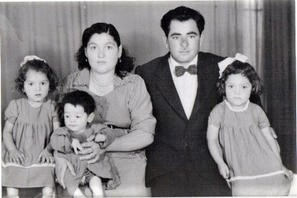
All the photos on this page are from the personal family photos of Ismail Veli ‘Kirlapo’
Fatma Ali ‘Giccu’. Fatma Yusuf Phsillu'(Fatma Veli) & and Yasena Fatma ‘Giccu/Gadina’ was the only daughter of Emine Seid-Ali ‘Kilinciri’ & Hüseyin Mustafa ‘Gutsullo’ born 1858
İsmail Ali ‘Tahuredi’ (Giçço) 1892-1965.husband of Fatma Hüseyin ‘Gadina’
Yusuf Ismail ‘Phsillo/Galaba & Melek Ismail ‘Giçço
Left Fatma Hüseyin ‘Gadina’ Giççu, Fatma Yusuf Phsillu, Melek Ismail ‘Yasena’
Melek Yusuf ‘Phsillu’ (seated) daughter of Fatma Hüseyin ‘Gadina’ (Giççu) and all her children. From left, Ayşe, Osman, Emine, Ziliha, Fatma and grandadughter Ayla
Ismail Veli and Cavidan Ali. Ismail is the great great grandson of Emine Seid-Ali ‘Kilinciri’ & Hüseyin Mustafa ‘Gutsullo’ born 1858
This family’s origins are from Dali. The Cidari’s & Badadi’s, Lauzarda, Badudi, Muraci, Gudalaridi, Stuppomades, Kufi & Paşo form part of this family group
BAİRAM ‘Cidaris’.
1 Murat Süleyman Bairam ‘Cidaris’ born 1796
2 Dudu Süleyman Bairam ‘Cidaris’ born 1798
MURAT SULEYMAN BAİRAM BORN 1796. [1] married DUDU MURAT born 1800
their children
1 Mustafa Murat ‘Badudi’ 1828-1897. [2] married Rahme Mustafa born 1829
2 Bairam Murat born 1829 married Zeliha Osman born 1836. They married in 1848
3 İsmail Murat ‘Cidari’ 1829-1840
4 Süleyman Murat ‘Ahamadis’ born 1839 married Ayşe Ahmet. They married in 1866
5 İsmail Murat ‘Stuppomades/Cidari’ born 1841 [3] (probably named after his deceased brother) married Raziye Ramadan ‘Musurda’ born 1844. They married in 1862
6 İbrahim Murat ‘Buzi/Cidari’ born 1844 married Zalihe Hüseyin ‘Kulea’ born 1846 they married in 1867
MUSTAFA MURAT ‘Badudi’ 1828-1897. Married RAHME MUSTAFA born 1829, married in 1950
their children
1 Murat Mustafa ‘Badudi’ born 1860. Married Rahme Hasan born 1863
2 Osman Mustafa ‘Gudalaridi’ born 1870.
3 Yusuf Mustafa ‘Kufi’ born 1878.
4 Dudu Mustafa married Emir-Ali ‘Porto’
5 Ayşe Mustafa ‘Badudi’ born 1856
6 Emine Mustafa ‘Galabina/Badudi’ married İsmail Ramadan ‘Galaba’ born 1862
MURAT MUSTAFA ‘Badudi/Muraçi’ born 1866 married RAHME HASAN ‘Riala’ born 1863
their children
1 Hasan Murat ‘Muraçi’born 1889
2 Raif Murat ‘Muraçi’ born 25.10.1893-1974
3 Mehmet Murat ‘Muraçi’ married in Bahçeler village
4 Emine Murat ‘Muraçi’ married Mustafa Ramadan ‘Kara Mustafa/Ramadi’ 1877-1967
5 Dudu Murat ”Muraçi/ Videnna’ 1894-1984 married Hüseyin ‘Vidinni’ 1887-1976
6 Şerife Murat ‘Muraçi’ 1st wife of Osman Murat ‘usta/Ebistat’ 1896-1983 His 1st was murdered by ‘Gombo’? [4]
7 Ahmet Murat born 1902 died young.
HASAN MURAT ‘Muraçi’ born 1889 1st wife name not found. 2nd marriage ŞERİFE YUSUF ’Şila’ 1896-1972
their children
1st marriage
1 Fatma Hasan’Muraçi’ married a Libyan where they lived in Tripoli, Libya and they had 11 children, names not known
1 Yusuf/Ziya Hasan (Aykol) ‘Muraçi’ 1924-1882 (2nd Marriage)
YUSUF ZİYA HASAN AYKOL ‘Muraçi’ 1924-1882 married VEDİA BEKİR ‘Salihi’ 1931-1985
their children
1 Hasan Ziya Hasan Aykol ‘Muraçi’ 1957-2003 married Dudu Fuat Azaerler
2 Salih Ziya Hasan Ayko l’Muraçi’ 1960-2007 married İlgin from Sinde
3 Erdal Ziya Hasan Aykol ‘Muraçi’
4 Mehmet Ziya Hasan Aykol ‘Muraçi’
5 Murat Ziya Hasan Aykol ‘Muraçi’
6 Şermin Ziya Hasan Aykol ‘Muraçi’ married Arif Yusuf ‘Türk/Yusufigo’
HASAN ZİYA HASAN AYKOL ‘Muraçi’ 1957-2003 married DUDU FUAT AZAERLER
Their children
1 Ziya Hasan Aykol ‘Muraçi’
2 Vedia Hasan Aykol ‘Muraçi’ 1986-2001
3 Çağan Hasan Aykol ‘Muraçi’
ZİYA HASAN AYKOL ‘Muraçi’ married EYGÜ NEVZAT YILDIRIM
Their children
1 Hasan Ziya Aykol ‘Muraçi’
2 Şermin Ziya Hasan Aykol married Arif Yusuf ‘Türk/Yusufigo’
3 Salih Ziya Hasan Akyol Married İlgin from Sinde
4 Erdal Ziya Hasan Aykol married Aykan Zeki Ernaz ‘Gudalaridi/Zeki usta’
5 Mehmet Ziya Hasan Aykol married Çınar Süleyman ’Paşi’
6 Murat Ziya Hasan Aykol
SALİH ZİYA HASAN AYKOL ‘Muraçi’ 1960-2007 married İLGİN from Sinde
Children
1 Dilan Aykol ‘Muraçi’, adopted
ERDAL ZİYA HASAN AYKOLborn 1963 married AYDAN ZEKİ ERNAZ ‘Gudalaridi/Zeki usta’
his children
1 Ziya Erdal Aykol ‘Muraçi’
2 Zeki Erdal Aykol ‘Muraçi’
MEHMET ZİYA AYKOL ‘Muraçi ‘married ÇINAR SÜLEYMAN ‘Paşi’
Their children
1 Süleyman Mehmet Aykol ‘Muraçi’
2 Ziya Mehmet Aykol ‘Muraçi’
3 Meliha Mehmet Aykol ‘Muraçi’
ŞERMİN ZİYA AYKOL ’Muraçi’ married ARİF YUSUF TÜRK ‘Yusufigo’
their children
1 Ece Türk ’Yusufigo’
2 Aykut Türk ’Yusufigo’
3 Selin Türk ’Yusufigo’
4 Vedia Türk ’Yusufigo’
RAİF MURAT ‘Muraci’ born 25.10.1893-1974 married ZELİHA HASAN ’Karaca’
their children
1 Dudu Raif married Kemal Veli ‘Pekri
2 Rebia Raif married Mehmet Arif ‘Muslu’
DUDU RAİF ‘Muraci’ married KEMAL VELİ PEKRİ ’Pekri/ Kemal usta’
their children
1 Emine Pekri ’Pekri/ Kemal usta’
2 Zeliha Pekri ’Pekri/Kemal usta’
REBİA RAİF ‘Muraci’ married MEHMET ARİF Muslu ’Muslu/Şemmedo’ 1925-1996
their children
1 Raif Muslu ’Şemmedo’ 1958-2008
2 Emine Muslu ’Şemmedo’
3 Hasan Muslu ’Şemmedo’
4 Arif Muslu ’Şemmedo’
MEHMET MURAT ‘Muraci’ married AYŞE from Bahçeler village
his children
1 Murat Mehmet ‘Muraci’ married Sevgi Cemil ‘Kufi’
2 Destine Mehmet ‘Muraci married Mustafa from Vadili
MURAT MEHMET ’Muraçi’ married SEVGİ CEMİL ’Kufi’
their children
1 Şenol Murat ’Muraçi’
2 Birol Murat ’Muraçi’
DESTİNE MEHMET ’Muraçi’ married MUSTAFA from Vadili
their children
1 Ayşen Mustafa
2 Yeşim Mustafa
EMİNE MURAT ’Muraçi’ married MUSTAFA RAMADAN ’Kara Mustafa/Ramadi’ 1877-1967
their children
1 Ramadan Mustafa ’Kara Mustafa’ 1909-2000
2 Dudu Mustafa ’Kara Mustafa’ 1910-2004
3 Şerife Mustafa ’Kara Mustafa 1919-2000
4 Remziye Mustafa ’Kara Mustafa 1923-2010
DUDU MURAT ’Muraçi’/Viddena’ 1894-1984 married HÜSEYİN YUSUF ’Vidinni’ 1887-1976
their children
1 Yusuf Hüseyin ’Viddini’
2 Rabia Hüseyin ’Viddini’
ŞERİFE MURAT ’Maraci’ married OSMAN MURAT ’Usta/Ebistat’ 1896-1983
their children
1 Murat Osman Uçkan ’Osman usta/Ebistat’
2 Hasan Osman Uçkan ’Osman usta/Ebistat’
3 Emine Osman Uçkan ’Osman usta/Ebistat’
OSMAN MUSTAFA ‘Gudalaridi/Badudi’ born 1870 married DUDU MUSTAFA ’Arnavut’
their children
1 Mustafa Osman ‘Gudalaridi’ ‘Mustafella’ born 1890 ‘married Maria Petri ‘Mariku’ born 1895
2 Yusuf Osman ‘Gudalaridi’ born 1892
3 Recep Osman ‘Gudalaridi’ born 1895
4 Mehmet Osman ‘Tsende’ never married
5 Ali Osman (Besen) born 23.10.1905-1983
6 Emine Osman married İbrahım Hasan ‘Glavyalı
7 Latif Osman ’Petletis born 1895. died young
8 Ahmet Osman born 1902. died young. [5]
MUSTAFA OSMAN ‘Gudalaridi’ ‘Mustafella’ born 1890 married MARİA PETRİ ‘Mariku’ born 1895
their children
1 Aliye Mustafa from Maria’s 1st marriage
2 İbrahım Mustafa ‘Cici’ (Mustafella’) born 16. 08.1920- 1986 married Emine Veli ‘Kirlapo’ born 1932-1969
3 Dudu Mustafa ’ ’Mustafella’
4 Yorgi Mustafa (born Mehmet Mustafa, changed his name to Yorgi and moved to Anglisides village)
İBRAHIM MUSTAFA ‘Cici’/Mustafella’ 1922-1986 married ŞERİFE MEHMET ‘Kaplan’ ‘Şerinya’ 1923-1996 2nd marriage to ‘EMİNE VELİ ‘Kirlapo’ 22.03.1932-June 1969. (6)
their children
1 Sabiha İbrahım 16.11.1944- 13.01.2024 (from ‘Gici’s first marriage to Şerife Mehmet ‘Şerinya’ ) married Kamil Veli ‘Kirlapo born 01.01.1944 -10.09.1974
2 Şermin İbrahim 1948-1999 married Soner Karagözlü ‘Tai’.
3 Mustafa İbrahim ‘Musti’ married Gülten
4 Suzan İbrahım born 1958 married Özdemir. died in a car crash 1977-78
SABİHA İBRAHIM 16.11.1944 ‘Cici/Mustafella’ married KAMİL VELI ‘Kirlapo’ 01.01.1944-10.09.1974
Their children
1 Şerife Kamil born 1963
2 Emine Kamil born 09.03.1970
ŞERMİN İBRAHIM ‘Cici/Mustafella’ 1948-1999 married SONER MUSTAFA ‘Tay’ born 19.11.1947 Divorced in the early 1970’s
their children
1 Ayşe Soner Karagözlü ( Mavromadi ) from 1st marriage Şermin
2 Emine Soner Karagözlü ( Mavromadi ) from 1st marriage Şermin
MUSTAFA İBRAHIM ‘Musti/Cici/Mustafella’. married GÜLTEN
their children
1 İbrahim Mustafa ’Cici’
2 Emine Mustafa ’Cici’
SUZAN İBRAHIM ‘Cici/Mustafella’. born 1958 married ÖZDEMİR from Turkey. He died in a tragic car accident in Turkey, late 1970’s early 1980’s
their children
1 Tolga
2 Tarkan
3 Timur
DUDU MUSTAFA ’Mustafella’ married NAİM MEHMET EMİN ( NAİMOĞLU) from Dali
their children
1 Mustafa Naimoğlu married Aysel Veli ‘Kundi’
2 Hüseyin Naimoğlu married Melek Osman ‘Pire’
3 Cemal Naimoğlu married Zehra from Yeniceköy/Petra tou Diğeni
4 Turgut Naimoğlu married Cevriye from Morfu
5 Mehmet Naimoğlu
6 Nazire Naimoğlu (Mehmet Emin)married Mehmet Özkerem from Petrofan
7 Müsteyde Naimoğlu (Mehmet Emin) married Kadir Karabulut from Turkey
MUSTAFA NAİM NAİMOĞLU married AYSEL VELİ ’Kundi’
their children
1 Gül Naimoğlu
2 Nur Naimoğlu
HÜSEYİN NAİM NAİMOĞLU married MELEK OSMAN ’Pire’
their
1 Inanç Naimoğlu
2 Osman Naimoğlu
CEMAL NAİM NAİMOĞLU married ZEHRA from Yeniceköy/Petra tou Diğeni
their children
1 Naim Naimoğlu
2 Derviş Naimoglu
TURGUT NAİM NAİMOĞLU married CEVRİYE from Morfu
their children ?
NAZİRE NAİM NAİMOĞLU /MEHMET EMİN married MEHMET ÖZKEREM from Petrofan
their children
1 Ali Özkerem
2 Topel Özkerem
3 Gülvin Özkerem
4 Sultan Özkerem
5 Hasan Özkerem
6 Naim Özkerem
7 Duyal Özkerem
8 Ayşe Özkerem
MÜSTEYDE NAİM NAİMOĞLU/MEHMET EMİN 1st marriage KADİR KARABULUT from Turkey. 2nd marriage RAGIB ERDOĞDULU from Pafos
children from 1st marriage
1 Naim Karabulut
2 Fadime Karabulut
children from 2nd marriage
1 Rahme Erdoğdulu
2 Hasan Erdoğdulu
ALİYE MUSTAFA ’Mustafella’ married HASAN NURİ from Matyat’Mathiatis
their children
1 Yusuf Hasan Nuri
2 Nuriye Hasan Nuri
3 Günay Hasan Nuri
4 İbrahim Hasan Nuri
YUSUF OSMAN ‘Gudalaridi’ born 1892 married HAYRİYE YUSUF ’Viddini’ 1898-1988
their children
1 Osman Yusuf ‘Gudalaridi/Gada’ married Meyrem İsmail ’İtelli’
2 Nayle/Nazlı Yusuf ‘Gudalaridi/Gada’ 1928-2000 married Yusuf Ali from Larnaca’
3 Salime Yusuf ‘Gudalaridi/Gada’ married Osman Ramadan ‘Pekri’
OSMAN YUSUF ‘Gudalaridi’ (Özyanak) married MEYREM İSMAİL ’İtelli’
their children
1 Zafer Osman ’Gada’(Özyanak) ’Gada’ married Pelin Hüseyin from Paşaköy
2 İsmail Osman ’Gada’ (Özyanak)
3 Ersoy Osman ’Gada’ (Özyanak) married Gülin İbrahim
4 Hilal Osman ’Gada’ (Özyanak) married Hasan from Ağridağ
5 Erkan Osman ’Gada’ (Özyanak) married Yılmaz Kaygısız from Değirmenlik/Kythrea
ZAFER OSMAN ÖZYANAK ’Gada’ married PELİN HÜSEYIN from Paşaköy
their children
1 Hüseyin Özyanak ’Gada’
ERSOY OSMAN ÖZYANAK ’Gada’ married GÜLİN İBRAHİM ÖZER ’Dima/Bata’
their children
1 İbrahim
HİLAL OSMAN ÖZYANAK ’Gada’ married Hasan CİNGÖZ from Ağirdağ
their children
1 Ahmet Cingöz
ERKAN OSMAN ÖZYANAK ’Gada’ married YILMAZ KAYGISIZ from Değirmenlik/Kythrea
their children
1 Can Kaygısız
NAZLİ YUSUF ’Gada’ 1928-2000 married YUSUF ALİ ’Darbukacı’ 1931-2002
their children
1 Hayriye Yusuf ’Darbukacı’
2 Ali Yusuf ’Darbukacı’ 1953-2013
3 Fatma Yusuf ’Darbukacı’
4 İlker Yusuf ’Darbukacı’
5 Sonal Yusuf ’Darbukacı’
HAYRİYE YUSUF ’Darbukacı married TUNCER MUSTAFA ÖZBOŞNAK ’Muzafferi’
their children
1 Açelya Özbosnak ’Muzafferi’ (was adopted)
ALİ YUSUF ’Darbukacı 1953 2013 married ÖZGÜL from Nicosia
their children
1 Erkmen Ali ’Darbukacı’
FATMA YUSUF ’Darbukacı married MEHMET DAĞLI from Gönendere
their children
1 Evşen Dağlı
2 Özlem Dağlı
3 Hasan Dağlı
İLKER YUSUF ’Darbukacı married SOLEY from Alsancak
their children
1 Yusuf İlker ’Darbukacı’
2 Meliha İlker ’Darbukacı’
SONAL YUSUF ’Darbukacı’ married ÖMREL from Mutluyaka
their children
1 Ömer Sonal ’Darbukacı’
2 Nazlı Sonal ’Darbukacı’
SALİME YUSUF ’Gada’ married OSMAN RAMADAN AĞDAÇ ‘Grivas/Zardaganya/ ‘Grivas’ (Pekri) 1931-2008
their children
1 Yusuf Osman Ağdaç ’Grivas’
2 Ramadan Osman Ağdaç ’Grivas’
3 Emcet Osman Ağdaç ’Grivas’
4 Öner Osman Ağdaç ’Grivas’
5 Civan Osman Ağdaç ’Grivas’ married Mustafa Özkılıc
6 Cavidan Osman Ağdaç’ ’Grivas’ Taner Canselen
7 Canan Osman Ağdaç ’Grivas’ married Şevket Aktunç
8 Cihan Osman Ağdaç ’Grivas’ Married Cengiz Korkmazhan
9 Derya Osman Ağdaç ’Grivas’ married Türkeş Bambeş
10 Duyal Osman Ağdaç ’Grivas’ married Ali Dinçol
RECEB OSMAN ‘Gudalaridi’ (Ernaz) born 1895 married ŞERİFE HASAN ’Recebu/İsmailo’
their children
1 Osman Zeki Recep ’Zeki usta’ (Ernaz) 1928-1992 married Emine İbrahim
YUSUF MUSTAFA ‘Küfi/Badudi’ born 1878 married DUDU MURAT ’Gufina/Çıkırıkçı’
their children
1 Ali Yusuf ‘Küfi’ born 1900? died during infancy
2 İzzet Yusuf ‘Küfi’ 1900-1982 1st marriage Şerife Yusuf ’Babui’. 2nd marriage Emine Hasan ’Izzetu/Hasan Ağa’ 1901-1990
3 Cemil Yusuf ‘Küfi
4 Emine Yusuf ‘Küfi’ 1897-1975 married Hüdaverdi Bairam
5 Rebgeli Yusuf ‘Küfi’ married İbrahım Kara İsmail ‘Topal’
6 Dudu/Ayşe Yusuf ‘Küfi’ married Hüseyin Ömer ‘Gugo’
İZZET YUSUF ‘Küfi’ 1900-1982 1st marriage ŞERİFE YUSUF ’Babui’. 2nd marriage EMİNE HASAN ’Izzetu/Hasan Ağa’ 1901-1990
Children from 2nd marriage
1 Yusuf İzzet ‘Küfi’ married Meral Mehmet ’Gonyelo
2 Şerife İzzet ‘Küfi’ married İsmail Kale
YUSUF İZZET ‘Küfi’ married MERAL MEHMET ’Gonyelo’
their children
1 İzzet Yusuf ‘Küfi’
2 Çimen Yusuf ‘Küfi’ born 1963 married Hüseyin Ahmet Doğan ’Onbaşı’
3 Yeşim Yusuf ‘Küfi’ married Kasım Alamzai from Afghanistan
İZZET YUSUF ’Küfi married TİJEN İBRAHİM AĞDIRAN ’Mulla/Englezzo’ born 1967
their children
1 Yusuf İzzet ’Küfi’
2 Meral İzzet ’Küfi’
ÇİMEN YUSUF ’Küfi’ born 1963 married HÜSEYİN AHMET DOĞAN ’Onbaşı’
their children
1 Yusuf Doğan ’Onbaşı’
2 Halide Doğan ’Onbaşı’
YEŞİM YUSUF ’Küfi’ married KASIM ALAMZAİ from Afghanistan
no information on children
ŞERİFE İZZET ’Küfi’ married İSMAİL MUSTAFA ’Kale/Semani’
their children
1 Izzet İsmail ’Kale’
2 Emine İsmail ’Kale’
CEMİL YUSUF ‘Küfi’ married HATEM OSMAN ’Cemilu/Musko’
their children
1 Yusuf Cemil ‘Küfi’
2 İzzet Cemil ‘Küfi’
3 Osman Cemil ‘Küfi’
4 Sevgi Cemil ‘Küfi’ married Murat Mehmet ‘Muraçi’
SEVGİ CEMİL ’Küfi’ married MURAT MEHMET ’Muraçi’
their children
1 Şenol Murat ’Muraçi’
2 Birol Murat ’Muraçi’
EMİNE YUSUF ’Filaerdina/Küfi’ born 1897-1975 married HÜDAVERDİ BAYRAM ’Burundi’ born 1892 married
their children
1 Kemal Hüdaverdi ‘Burundi’ (Hüdasoy) 1925-2014 married Duran Mehmet ‘Bedasi’
2 Yusuf Hüdaverdi ‘Burundi’ married Katriye Murat ‘Deliyo’ (Yakula)
3 Mediha Hüdaverdi ‘Burundi’ married Mustafa ‘Kamalo’
RABİA YUSUF ’Küfi’ married İBRAHIM İSMAİL KARA-İSMAIL ‘Topal’
their children
1 İsmail Topal İbrahım ‘Topal/Barasussul/Lappo’
2 Fatma Topal İbrahım ‘Topal’ married Hasan Arif ‘Muslu’
3 Meserret Topal İbrahım married İbrahım Mehmet ‘Mustafuri’
5 Emine Topal İbrahım married Hasan Mehmet ‘Pladanisyali’
AYŞE YUSUF ‘Küfi’ married HÜSEYİN ÖMER ‘Gugo/Deli Ömer’’ (Tümsek).born 1900 [7)
their children
1 Ömer Hüseyin Ömer ‘Gugo’ (Tümsek) married Hatem migrated to Australia
2 Yusuf Hüseyin Ömer ‘Gugo’ (Tümsek) born 1943 migrated to UK married Tumral from Afanya
3 Mukkadez Hüseyin Ömer ‘Gugo.Çerkezu’ (Tümsek) migrated to Australia
4 Emine Hüseyin Ömer ‘Gugo’ (Tümsek) migrated to Australia
5 Oral Hüseyin Ömer ‘Gugo’ (Tümsek) migrated to Australia
6 Soner Hüseyin Ömer ‘Gugo’ (Tümsek) married Emel from Lefkoşa migrated to Australia
7 Özkan Hüseyin Ömer ‘Gugo’ (Tümsek)
8 Nebile Hüseyin Ömer ‘Gugo’ (Tümsek) married Derviş Abbas
EMİR-ALİ MUSTAFA ‘Porto/Komurci’ born 1841 married DUDU MUSTAFA ’Badudi ‘Komurcina’. [8]
their children
1 Yusuf Emir-Ali ‘Efe’ born 1872. From 1st wife Şerife. 2nd wife Dudu ‘Buruncika’
2 Mustafa Emir-Ali ‘ Manna’ 1885-1958 married Dudu Hasan ‘Mannina’ ( Hasan Turlumbi’s daughter) 1895-1977.
3 Murat Emir-Ali Murrati’ 18,04-1892-3 married Dudu
4 Ayşe Emir-Ali ‘Cafalalina’ married to Ali ‘Cefalali’ (Eşeo)
5 Hüseyin Emir-Ali ‘Gülle’ died when a child
EMİNE MUSTAFA ‘Badudi/Galabina’ married İSMAIL RAMADAN ‘Galaba’ born 1862 [9]
their children
1 Ramadan İsmail ‘Galaba’ married Keziban Bekir ‘Guri-yua
2 Bekir İsmail ‘Galaba’ Had no children
3 Mustafa İsmail Galaba had no children
4 Yusuf İsmail ‘Galaba’ 1903-4- 23.04.1970 (Phsillo) married Melek İsmail ‘Phsillu’ 1908- 14.12.1988
BAİRAM MURAT born 1829 married ZELİHA OSMAN born 1836 They married in 1848.[10]
their children
1 Osman Bairam ‘Yankeş’ born 1856 Died from a lightning strike. (11)
2 Yusuf Bairam ‘Lauzarda’ born 1859
3 Abdurrahman Bairam
4 Hatem Bairam born 1859 married İbrahım Süleyman ‘Yasumullo’
5 Dudu Bairam born married Mustafa ‘Tari’
6 Emine Bairam born 1862 married Murat Emir-Ali ‘Midillu’
7 Rahme Bairam born 1863
8 Hanim was born in 1859 recorded as Kerimesi. She may have been Hatem’s twin and died young. No other information exists on her.
OSMAN BAİRAM ‘Yankeş/Cidari’ born 1856 1st marriage ZALİHE OSMAN ’Damba’. 2nd Marriage HACER HASAN ’Riala/Birleppa’
all the children were from the 2nd marriage
1 Ayşe Osman ’Yankeş married İbrahım Yusuf ‘Bambulos/Kırmızı/Gologa’
2 Zalihe Osman ’Yankes/Malacina’ married Murat Mehmet ‘Ftiri’ and then Mustafa ”Malaga’?
3 Osman Osman ‘Yankesh’ died very young from an epileptic fit. (named after his father who died, as a result of a lightning strike during his mothers pregnancy)
AYŞE OSMAN ’Yankeş’ married İBRAHİM YUSUF ‘Bambulo/Kırmızı/Gologa’ born 1872
their children
1 Yusuf İbrahim ’Bambulos’ 1899-1959
2 Osman İbrahim ’Bambulos’
3 Mehmet Nazif İbrahim ’Bambulos’
4 Arife İbrahim ’Bambulos’
5 Emine İbrahim ’Bambulos’
6 Kerime İbrahim ’Bambulos’
ZALİHE OSMAN ’Yankeş’ 1st marriage MURAT MEHMET ’Ftiri/Tari’ 1972-1895. 2nd marriage MUSTAFA ’Malago’ from Tuzla
1st marriage
1 Murat Murat ’Ftiri’ born 1895 same year as the death of his father.
2nd marriage
2 Osman Mustafa ’Malago’ 1904-1980
3 Ayşe Mustafa ’Malago’
OSMAN MUSTAFA ’Malago’ 1904-1980 married ZÜRİYE from Monyat
their children
2 Fuat Mustafa ’Malago’
3 Behiye Mustafa ’Malago’
AYŞE MUSTAFA ’Malago’ married YUSUF MEHMET ’Tsali’ 1904-1976
their children
1 Erdoğan Yusuf ’Tsali’ 1938-2010
2 Orhan Yusuf ’Tsali’
3 Fezile Yusuf ’Tsali’
YUSUF BAİRAM ‘Lauzarda/Cidari’ born 1859 married RAHME YUSUF ’Dirimo’ born 1958
their children
1 İsmail Yusuf ‘Lauzarda’ born 1885
İSMAİL YUSUF ’Lauzarda’ born 1885 married REBYELİ SÜLEYMAN ’Babiri/Lauzardina’
their children
1 Derviş İsmail ’Polis/Lauzarda’
2 Süleyman İsmail ’Lauzarda’
DERVİŞ İSMAİL ’Polis/Lauzarda’ married KERİME BEKİR ’Kelle’
their children
1 İsmail Derviş (Erbolay) ’Lauzarda’
2 Aydın Derviş (Erbolay) ’Lauzarda’
3 Rabia Derviş ’Lauzarda’
4 Aysel Derviş ’Lauzarda’
İSMAİL DERVİŞ ERBOLAY ’Lauzarda’ married HACER EMİRALİ ÖZKILIÇ ’Stillo’
their children
1 Derviş İsmail Erbolay ’Lauzarda’
2 Emirali İsmail Erbolay ’Lauzarda’
3 Emine İsmail Erbolay ’Lauzarda’
AYDIN DERVİŞ ERBOLAY ’Lauzarda’ married TİJEN ’Kelle’
their children
1 Yudum Erbolay ’Lauzarda’
2 Pınar Erbolay ’Lauzarda’
3 Yağmur Erbolay ’Lauzarda’
RABİA DERVİŞ ’Lauzarda’ married BEKİR RİFAT HINCAL
their children
1 Evren Hıncal
2 Evrim Hincal
AYSEL DERVİŞ ’Lauzarda’ married MUSTAFA KULAÇ from Dohni
MELEK İBRAHİM ’Buzzi’ born 1868 married YUSUF RAMADAN ’Mavri/Zorno’ born 1877
their children
1 Ramadan Yusuf ’Mavri/Nalbant’
DUDU İBRAHİM ’Buzzi/Furnaru’ married HÜSEYİN HASAN ‘Riala’ born 1875
their children
1 Hasan Hüseyin ‘Riala’ ‘ Gaşeyi’ ( now known as the Akıncı family)
2 Osman Hüseyin ‘Riala/Mecidi/Makuda’ had no children
3 Refide Hüseyin ‘Riala’ 1st wife of Yusuf Süleyman ‘Gato’
4 Emine Hüseyin ‘Riala’ 1st wife of Veli Kerlo
MUSTAFA MEHMET ‘Kazmalevri’ born 1796-1885 (1813 according to one census) married DUDU BAYRAM born 1798 they married in 1829. [15]
their children
1 Yusuf Mustafa born 1830 died young.
2 Mehmet Mustafa ‘Gatsura/Yalluri’ born 1830-1885 (year of 1835 according to the 1879-1880 census) (16) married Dudu Mustafa ‘Gigeo’ born 1844 they married in 1856
3 Ramadan (Ramazan) Mustafa ‘Ramadi’ born 1842 married Rabia Mustafa ’Çıkırıkçi born 1848
4 Mustafa Mustafa ‘Kidioli’ born 1841.
5 Ali Mustafa ‘Kali’ born 1835 married 1st Ayşe Mustafa born 1843, they married in 1865. 2nd marriage to Yasemin from Kalopsida village.
6 İbrahim Mustafa ‘Braimulli’ 1844-1892 married Melek Mustafa ’Melleka/Paça’
7 Razgeli Mustafa born 1839 married Süleyman ‘Buzzi’
8 Hatice Mustafa born 1855-1901? moved to Anglisiya village
9 Salih Mustafa born 1855
Important note. Unfortunately the census of 1833 and 1879-80 had some discrepancies on the ages of individuals, hench the confusion on the above list
(1) T.C Başbakanlık Osmanlı Arşivleri. Book TŞR.KB.d.00040. Pages 45 ve 46. Person No;
(2) The Milli arşiv ve araştırma dairesinde 67 numarada kayıt. 1889,1890,1893,1897,1906
kayıtlar. page 136, family No; 10
(3) T.C Başbakanlık Osmanlı Arşivleri. Book TŞR.KB.d.00040. Pages 45 ve 46. Person No;94) Records of İbrahım Tahsildar The Murat Cidari family. page 197
(5) Latif Petletis & Ahmet have not been found on any other record, neither do they have any known family. My conclusion is they died young. The Milli arşiv ve araştırma dairesinde 67 numarada kayıt. 1889,1890,1893,1897,1906 kayıtlar. page 136, family No; 10.
(6) This families details known due to being relatives of the author
(9) Ottoman census 1879 Doc No; 162-a-2 page 323. person No; 5650.
(10) Ottoman census 1879 Doc; 158-a-1 page 315
(11) Records of İbrahım Tahsildar The Murat Cidari family. page 196
(12) Dates and names from a personal interview with Leman Yusuf
(13) Ottoman census 1879. Doc 161-a-1 page 321. Ref No; 5611. (great great grandparents of the researcher of this project İsmail Veli ‘Kirlapo’.
(14) Records of İbrahım Tahsildar The Murat Cidari family. page 195
(15) It’s my belief that the Ottoman census 1879. Doc; 151-a-1 page 301 official recording accidently wrote Mustafa’s and his wife Dudu’s year of birth the wrong way round.. The 1831 T.C Başbakanlık Osmanlı Arşivleri. Book TŞR.KB.d.00040. Pages 45 ve 46. Person No; 77. seems to confirm this as it records Mustafa as being 35 years old. This means his year of birth was 1796-7 and not 1813 as recorded in 1879.
(16) Ottoman census 1879. Doc; 154-a-2 page 307. 5373-5374
In addition to the personal collection of Ismail Veli ‘Kirlapo’, the photos on this page have kindly been shared by the following persons
Benny Rassmusen
Mehmet Çarman (M. Murat ‘Çarta’)
Mehmet Osman ‘Tsende’
Mehmet Osman ‘Tsende’
Maria Petri ‘Mariku’
Aliye Mustafa ‘Mustafella’
İbrahım Mustafa ‘Cici’ (Mustafella’),Suzan İbrahım & Özdemir with his mother
İbrahım Mustafa ‘Cici’ (Mustafella’)
Yorgi Mustafa ‘Mustafella’
Şermin & Suzanne İbrahım
Emine Veli ‘Kirlapo’, İbrahım Mustafa ‘Mustafella’ & Behice İbrahım ‘Gannu’
From middle Emine Veli ‘Kirlapo’, İbrahım Mustafa ‘Mustafella
İbrahım Mustafa ‘Mustafella
Seated Emine Veli ‘Kirlapo’, standing İbrahım Mustafa ‘Mustafella children Mustafa & Şermin
KKTC YAKIN DOĞU ÜNİVERSİTESİ EĞİTİM BİLİMLERİ ENSTİTÜSÜ
OSMANLICA PALEOGRAFYASI VE ARŞİVCİLİK EĞİTİMİ
Milli Arşiv ve Araştırma Dairesi. Girne/Kyrenia
1879 Osmanli nufus rekorları
T.C Başbakanlık Osmanlı Arşivleri, TŞR.KB.d.00040 numaralı defterin 45 ve 46 numaralı sayfalarında bulunan Luricina’da yaşayan Müslüman erkeklerin isimleri. Tarih: 1831
The Republic of Turkey. Prime Ministerial Ottoman archives. Book TŞR.KB.d.00040 Pages 45 and 46 of the Muslim male population of Lurucina. 1831
The National archives of Ottoman records. Istanbul, Turkey.
Şehit Ailelerı ve Malul Gaziler Derneği.
“The Cypriot Volunteers of the 2nd World War: the registers, catalogues and blood sacrifice”, publisher: Cultural Services of the Ministry of Education and Culture. Author: Petros Papapolyviou.
Ottoman policy and administration in Cyprus after the conquest by Halil Inalcik
History studies. International Journal of History.
”The Archaeology of Past and Present in the Malloura Valley,” edited by Derek Counts, P. Nick Kardulias, and Michael Toumazou, 2012.
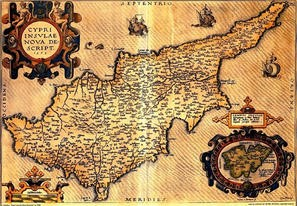
Cyprus 1542. The great map of the Island by Leonida Attar.
Edited by Francesca Cavazzana Romanelli & Gilles Grivaud
Published by the Bank of Cyprus Cultural Foundation.
The following historians work has been researched by Ersu Ekrem. Though he himself is not from Lurucina, his fascination on the research of Lurucina has prompted him to assist in any way possible. I cannot thank him enough.
Mustafa Hasim Altan. Mühimme Defteri (Mühimme book) XIX.
İskan Defteri ( Settlement Book) Republic of Turkey Prime ministerial Archives , Kamil Kepeci Defter ( Kepeci Book ) No 2551.
SPECIAL NOTE.
A special thanks to Ibrahim Tahsildar’s ‘Horolo’ family for sharing their records of the early parts of the family tree. it must alos be noted the Huseyin ‘Geleo’ also had a record of the original family trees of Lurucina. Its my understanding that together with Ibrahim, Huseyin & Mr Yusuf Yusuf ‘Ku’ upgraded to include many younger generations. I can only hope that my own additions with the help of countless individuals named below (Apologies for any missed names) has helped enhance our knowledge of our roots.
A massive thanks to the family of İbrahım Tahsildar, Alper Mehmet and Hüseyin Koca-İsmail who provided records of many family trees.and to the following people who’s material, and moral support gave me the courage and energy to complete the work.
Ersu Ekrem and his son Ekrem Cağan Ekrem who at 22 years of age designed the website www.familiesofluricina.moonfruit.com. Which assisted in collecting information from countless individuals. Ersu and Ekrem both spent endless hours in educating me on the usage of the computer. Accepted no pay for their efforts. Their support was, and is a model of what friendship is all about. In case anyone asks, they are not from Luricina.
Acknowledgements
Tina Kemran, Ramadan Ismail ‘Fesa’, Andreas Menlaos, Hayal Mehmet Kavaz, Andreas Menelaos, Şerife ‘Şheri’ and Hasan Yusuf, Hüssein Selim, Soner Karagözlu ‘Mavromadi’, Celal Kavaz, Kemal and Behice ‘Ado’, Mehmet and Sevilay Çarman ‘Çarta’, Leman and Bekir Mehmet ‘Bekircik’, Furiye Hüseyin Kara-İsmail & Zühtü Ramadan (Götsa/Gökşan) Yusuf Toz ‘Tozzi’, Eren Nasip Senior, Ramadan İsmail ‘Fesa’, Hüseyin Koca-Ismail, Emine İbrahım, Veli Cufoğlu, Mehmet Kavaz, Mustafa İbrahim ‘Culli’ ( Denizer) Hasan Avezer, Deniz Hoüssein, Lisa Sev Dawson, Osman Bekir ‘Bihigo’ and his friend Ekrem Cavit Oztürkler, Serpil Mehmet ‘Gatsura’, Hicran Alaz ‘Hijjy’, Feride and Hüseyin Paça, Deniz Huosein, Fred Yusuf, Sheniz Mullali (the late Murat ‘Kelleci’s daughter), Gürsoy Didem Savim, Gönül Salih, Mustafa Gelener. Martyn Ahmet ‘Minnos’, Anthony Georgiou, Yusuf Ahmet, Sermen Erdogan and many more who whether by telephone, mail or in person contributed in one way or another.
Last but not least my parents Mehmet Veli ‘Kirlapo’ and Fatma Mehmet ‘Phsillu’ who’s massive help and moral support from start to finish never yielded for one moment. And off course my wonderful wife and sons whose patience and support during this period encouraged me to carry on.
The distance of Australia, Cyprus, Turkey and the UK between the many people above was no obstacle to our closeness. The age of modern communication that has brought us all together deserves a mention in-itself.
The website was launched on 14 August 2011. At the time of launch I invited people to cooperate in helping to support and build information in helping us to uncover our roots. Since the call, I have been assisted by many intellects, historians and anyone with details however small from the many people from our village who have their own research on our village.
The response from ordinary people has been fantastic, as a result I have been adding, editing and updating information constantly.
As a result we have in a short period of time traced the vast majority of family trees to their original place of origin. We have added Ibrahim Tahsildar’s records, which were so generously shared by Alper Mehmet. A particular thank you also to Necip Yucelen who is the brother of Hasan Yucelen for giving me permission to share Hasan’s excellent research on our village history, and of course Hussein Selim abi for giving me Hasan’s book for inspection. A depth of gratitude is owed by all of us to the dedicated support of countless people.
Who would have guessed when we began our research that we would learn that the Gatsura, Paça and Yakula family originated from Silifke? Or the Kavaz, Bedasi, Galaba’s, Lao, Fesa’s, Kara-İsmail’s, Pekri’s and Barbaros first from Manisa in Turkey, on to Dali then Lurucina? Or that Tahura, Giço, Gutsulli from Turkey? The Çamuri, Kafa, Muya from Kalopsidya, The Şilioni, Gato’s 1st from an unknown Arab country, on to Pirga then Lurucina? The Garaoli’s, Tozzi’s from Köfünye and possibly Karaman, Turkey? The Mulla’s, Böyle’s from Hürrem bey who came from Antalya. The Porto’s, Efe’s, Aligunni from Dali? From The Bosnaks from Bosnia. The Arnauti’s from Albania These are all exciting finds.
It’s beginning to look like the vast majority of Turkish Lurucina goes back at most eleven generations. It is possible of course that there may have been some Turkish people in Lurucina before the 1750s but one look at the roots of the family trees and the conclusion is that most of us are relative newcomers.
According to Nazim Beratli the Cypriot historian who has possibly done the most comprehensive study of the origins of the Ottoman Turkish Cypriots there were two large waves of Turkish migrants to Cyprus. One from 1572 and a second between 1700 and 1750. Naturally there was an ongoing steady stream. But its the second wave that we need to concentrate on as all the evidence to date points to our ancestors settling in Lurucina from the second wave. There may be some who may have historic evidence to contradict this claim. If they have, then I would be the first to welcome any family lists/names prior to the period in question. One thing we all know is that our ancestors knowledge of Greek plus many Latin words have been incorporated into Lurucina’s local culture. The conclusion is that our families amalgamated with the existing local Greek or partially Latin origin people so well that Greek became their first language. At the same time they fiercely clung to their ethnic roots.
Some may say how could they speak Greek better then Turkish and not be originally Greek. The answer is simple. We have lived in the UK only 40-50 years and yet many of our youth use English as their first language while many cannot even speak Turkish. Let’s not forget that this is in an age of high literacy, massive access to Turkish TV, Media, Turkish school’s, Clubs, Football and other sports activities and endless Ballo’s. Compare that era with the 1700-1800s which saw most people confined to illiteracy, minimal number of schools, complete detachment from central government, and for most village folk hardly any knowledge of the outside world other then what certain officials related to them. Against this background the people of our village only concerned themselves with survival and local harmony. No doubt they passed on the oral history of their families and origins with pride. This gave them a sense of continuity, strength and comfort in the sound knowledge that in-spite of all the problems of day to day issues one thing would be certain. Their past was a guide to their future.
If at the end of our search we attempt to understand, recognise and know who, and where our ancestors originated from, than their gentle shadow will hang over us in the sound knowledge that they have not, and will not be forgotten.
The people of Lurucina, once the largest Turkish village in Cyprus, have spread around the world. From the 1950s to the 1970s, many left their homes to seek better lives, reducing the village population to around 400. While we often nostalgically remember the past closeness and large family gatherings, we tend to overlook the hardships, such as the lack of amenities and financial struggles. Despite the difficult conditions, the villagers were resilient, working hard in tough environments. When migration opportunities arose, they embraced them, facing new challenges with determination. Many, despite limited education and language barriers, successfully integrated into their new countries, establishing homes, businesses, and community centers. This page documents the experiences of those who journeyed by sea and rail, enduring long trips and sea sickness, but finding the adventure and new sights memorable. The journey by sea was a more affordable option compared to air travel, making it the preferred choice. As we look to a more comfortable future for our descendants, it is important to appreciate the efforts and experiences of our ancestors that have shaped our lives today.
If you have any stories that you would like to share please contact us and we will upload as soon as we can.
Mehmet Veli ‘Kirlapo’s first journey to the UK in order to explore the possibilities of permanent migration which finally took place in 1962. Born 12.08.1929 – 06.08.2020
It was the summer of 1957 when Mehmet Veli ‘Kirlapo’ undertook his first journey abroad. Leaning over the railings of the ship as the Filippo Grimani cut through the waves he was intrigued when something distracted his attention. A few metres away he noticed a young lady in her early 20s holding a baby 3-4 years old, she was arguing hysterically with a middle aged man when she frantically ran towards Mehmet crying profusely. Mehmet was the only person on the deck at the time. She began to ask for protection as the middle aged man was offering her £5 to prostitute herself. It seemed he was very insistent. In the 1950s, for a woman to be travelling on her own with a baby was no easy task. Mehmet annoyed at what he heard approached and told the other man to hide his face in shame and warned him that he would have him to answer to and in addition he would report his harassment to the ship’s captain. It seemed the young lady’s name was Erato and was joining her husband who had worked and saved enough money to bring his wife and son to the UK.
Feeling safe with Mehmet she sat on his dinner table and stayed with him throughout the journey and only left her room after a glance from her cabin door that the coast was clear. At 4.000 tons and only 150-200 passengers the Filippo Grimani though seemingly huge at the time was a tug boat compared to today’s cruise liners.
On arrival to the UK, thank you’s and goodbyes were said, and everyone was picked up by relatives at Victoria station. It was a hard 6-7 days journey but at last the trip was over.
A few months later Mehmet returned to Cyprus. Once his employment in Melusha to Ahmet and Nebile ended. He was helped by Ahmet find a job in Meneou village, near Larnaca. This meant that he would be away from his wife and 3 children for 2 months. On recommendation he contacted a middle aged family to rent rooms for his family. Unfortunately Yorgo & Angela only had one spare room and indicated that a family of 5 would be too much for them. Cypriots being what they are nevertheless offered coffee & cakes. My father started to explain that he had met a young lady from Meneou with a baby a few months ago on his journey to the UK. At a time of strict rules of conduct Yorgo and Angela were startled at this, they explained that Mehmet was talking about their daughter. Mehmet quickly explained the circumstances and Yorgo shook Mehmets hand, thanked him for helping and protecting his daughter and grandson. He called him a ‘Balligari’ ( a brave/hero in Greek). Yorgo and Angela then immediately told Mehmet that his whole family were welcomed to stay at their home for as long as they needed to. As it turned out the father later contacted his daughter Erato to tell her what had happened. Naturally she was shocked at the amazing coincidence and told her family to do their best for Mehmet and his family as she owed him her respect and security on her long journey.
My parents have always spoken in high regard for Yorgo and Angela. As a mark of respect for us being Muslims Angela was always eager to point out to my mother if there was any pork being cooked. She ensured that the food was cooked in separate pots. I’ve been told that she cared and played with me for endless hours. Though our stay was short my parents, Yorgo and Angela had become very attached to each other. The ladies in particular were crying when we departed.
Sadly after leaving Meneou they never saw each other again. Communication facilities were primitive and the massive migration from Cyprus and Lurucina in particular were immense. though I was less than a year old at the time I have always wondered what happened to Yorgo, Angela and in particular to Erato and her little son. If he is well and alive he would now be about 60-62 years old, possibly with grandchildren of his own.
Ismail Mehmet Veil ‘Kirlapo”s story. Arrived in the UK 25.09.1962.
It was 19 September 1962 when My mother, sister and I left Lurucina for a new life in the UK. The weather as always was hot and all the family, relatives and neighbours were in the Street outside İsmail ‘Giçço’ dede’s house in order to see us all off. Boarding the bus, the drive to Larnaca would be short. I clearly remember that on either side of the Road there were high trees which gave the impression of a natural tunnel. The next thing I remember is boarding a small boat to take us to the Ocean liner Messapia. At over 5,207 tons and a capacity of 236 passengers it seemed more gigantic then anything I had seen in my 6 years of life. Leaving the small boat to climb the shaky stairs which seemed more of a ladder than steps was a bit scary, but soon enough we boarded.
With us there were three other village members. Emine Yusuf ‘Taogori’, Mehmet ‘Babi’ and ‘Gordonbihdi’. We all felt safe, sad, apprehensive but excited at the same time.
The ship soon blew its horns and we were underway. Larnaca got dimmer and dimmer in the distance. We were leaving our homeland, but a part of us was left behind. Soon the only thing around the Messapia was the massive Mediterranean sea. It cut through the waves leaving great swathes of white tides behind. Our rooms were tiny but it was nothing that we were not used to. The food was excellent and with a cinema on board it seemed like a luxury cruise. It was not until the next morning that we realised what sleeping on a ship was like. The sea sickness was nothing like we knew and this would carry on day after day.
After a day or two the Messapia reached the port of Piraeus, and the day trip in Athens was an amazing experience. The Acropolis seemed to tower over Athens, and seemed majestic. The departure led us through the narrow Corinth canal. The Messapia had to turn off its engines and the tugboats were pulling the liner. There were many people above the canal’s mountain top cheering and yelling their greetings. The ship’s propellers turning as it was pulled made an awful noise that sounded like breaking bits of metal rolling down a hill. The purpose of the Corinth canal was to save precious journey time. The next stop was Naples in Italy. Our group wanted to hire a taxi and visit Mount Vesuvius towering over the region. My mother, having run very low on her meagre £2 spending money, declined the trip. Emine aba who was on a return trip to the UK and the other 2 friends would have none of it. They dragged us along. The only thing I remember of the day was that my sister Melek wanted a dolly. My mother simply could not afford it. She refused and my sister still talks about it after 50 years.
Next stop was probably Genoa in North West Italy. From there the train would take us to Calais travelling the length of France. As I recall it was a long night ride. One of the things that stick in my memory was the silhouettes of deer on the low slopes adjacent to the rail lines. The rest is blank. Our train drive into Victoria is as clear as yesterday. Exiting the train on the 25th September it felt very chilly. My father, auntie Sadiye and uncle Kamil were there to pick us up. Noticing that I was shivering, Sadiye auntie wrapped her coat around me. Our car drive took us to our first place of residence which was 31 Mackenzie Road, just behind Caledonian Road, London.
Sabriye Veli (Sabriye Ali). 16.12.1938 – 24.03.2006
Sadly as Sabriye Ali died on the 24.03.2006 her story has been written posthumously as described by her in numerous conversations.
Sabriye was only 18 years old when a marriage was arranged for her to Mehmet-Salih Ali, who was from the village of Dohni / Tashkent. The problem was that Mehmet-Salih was in the UK. He had just finished working in Egypt at the Suez canal during the British French invasion in 1956. On finishing his work contract he decided that settling in the UK offered him a better life.
Sabriye’s older sister Rahme was married to Mehmet Salih’s cousin Cemal. As was the common practise in those days arranging a marriage to a person of good character was considered an act of goodwill. The poverty in Cyprus at that time was immense and migrating to the UK was a dream to a better life.
Sabriye often talked about her fears, apprehension and excitement about marrying a man she had never met, but was convinced by the family that a better future lay in her accepting the arrangement. Though arranged marriages in Cyprus were generally not forced, pressure to accept a good match was often heavy if not immense.
On 25 September 1957 Sabriye, together with her sister in-law Sadiye Osman ‘Gato’ (married to Mustafa Veli ‘Kirlapo’) left Lurucina. All the family and friends were gathered in the village centre where they would board the bus to Larnaca. Wailing, excitement and sadness was an obvious outcome. People in those days knew that it may take years to see their loved ones again. Letters would take months and most often were written by a literate member of the family, then passed on to anyone who happened to travel back to the village. News of their arrival would take months to reach back to the family.
The Bus drive from Lurucina to Larnaca port was 13 miles and Sabriye cried all the way. For Sadiye it was not so bad as she was joining her husband who was already in the UK. The arrival at the port and subsequent boarding of the Fillipo Grimani was tense but a little exciting. They had never been out of the country before and the outside world was completely unknown. Being used to the outside life, Sabriye found the rooms a bit claustrophobic but reasonably comfortable. Within a day or two Piraeus harbour was in view. Taking advantage of the day in port they visited the Acropolis which she often described as “ÇOK GÜZEL”. It was a bit of a relief as the time spent on the ship was uncomfortable because of sea sickness. The tension was now beginning to ease and the site of the ship cutting through the waves provided some relaxing moments. The food was unfamiliar but still found to be rich and varied. Exploring the ship was interesting enough, but the highlight of the voyage was their next stop at Naples on the 29th September. The mountain of Vesuvius in the background was breath-taking. Sabriye often explained how beautiful she found the view, but could not always remember the day’s events.
Their disembarkation at Genoa meant that their journey with the Fillippo Grimani was at an end and the next phase was about to begin. The train ride was long and the crossing at Modane into France took place on the 1st October. Six days had passed but another 2 days of travel lay ahead. Sabriye described the train journey as long and uneventful. Sadly like most people she could not remember the ferry ride from Calais to Dover. The final destination to Victoria station was better remembered.
She often talked about missing the village and her friends, but was insistent that she never wanted to go back to live in Cyprus. Sadly it was not until the mid 1980s that she finally made her first trip back to Cyprus. She hardly recognised the changes that had taken place and often preferred to remember Lurucina as it was when she left it in 1957.
Gökmen Mehmet’s story. Born 10.12.1936. Arrived in the UK 1954. Courtesy of her daughter Tina Kemran.
I lived in Nicosia and was a dressmaker and hairdresser. In any case my family were hairdressers.
I came to the UK in 1954 because my sister lost her daughter in London, and I came to be with her and keep her company. I also had a brother here. My family paid for my ticket to come here.
I used to get letters from my sister, so I heard a bit about London. My husband came on a ship named the Messapia an Italian boat, but that was in 1948. Mine was a different boat, It was also Italian. It was the first time I was leaving Cyprus and I was happy. I wanted to see London.
I travelled on my own. I was only 17 years old and very happy and cheerful so I made many friends on the boat and everyone also seemed excited about their journey. If I explain what it was like people would think I was a snob, because I wore a different dress everyday, most people did not do that but I really enjoyed being smart. There was a Turkish couple from Kofunye and I became very close to them. There were also English tourists on the boat. The journey was nine days long. We finally got to Victoria train station and my sister came to pick me up. To me it (London) didn’t look different except the houses looked smaller. When I went to my sister’s house in Bermondsey it was also very small with a very small garden. My father’s house in Cyprus was very large and in the Greek quarter, but when I lived in Bermondsey our neighbours were Turkish. There were Turkish people everywhere. It was very surprising to me.
My first job in London was in a Jam factory and it was terrible. I only worked there for two or three weeks, because I wasn’t used to it. I can’t remember what exactly I was doing there. My sister’s husband found me a job in Aldgate as a machinist (seamstress). I enjoyed that. My last job before I got married was for a Jewish firm called Adastra in Tower Hill making trousers. I enjoyed it there and I was doing piece work. There were also many Turkish girls there. It was better than the jam factory. I used to get on the number one bus from Bermondsey which took me straight to work.
My future husband’s sister introduced me to her brother, who seemed to fancy me and they arranged a meeting. In those days we had arranged marriages. He was a handsome man and within two weeks we were married. He (Mehmet, her future husband) came with his father to ask for me. As was the custom I made him a Turkish coffee. I wasn’t shy or nervous because I was very modern in my country (Cyprus). I was twenty years old. I was glad I got married. There was no pinning money in those days, just presents. My husband used to have a nice job in Grosvenor House. It was beautiful and once a year I used to go to a party there. We had lovely times. When you’re young you enjoy life. I was looking for a man like him anyway. He was smart and different from most Cypriot people. He was very modern and loved life, parties and all that. The only thing he failed was trying to teach me to smoke. I’m glad I never did, and I’m sure he was also. We had two children together, both girls and we named them Sylvia and Tina.
Seyit Mehmet 04.12.1925 – 07.11.2007. Arrived in the UK in 1949. Shared posthumously by his Daughter Tina Kemran
I lived in Larnaca Cyprus where I was born. I was in the British army during WW2. I enlisted in 1942 I was demobbed in 1947. I spent some of my army service in Egypt, Palestine and Italy.
I always wanted to travel abroad as Cyprus was too small. I found Italy a big country and I wanted to see the world. I didn’t really know much about England before I came. All I knew about London was Arsenal. All I remember in the 1930s as a child is that Arsenal was one of the best football teams in England. And off-course the King and Queen. In school we were taught about King George V before he died in 1936.
After being demobbed and because my father was a police man the family also wanted me to join. After five years in the army I didn’t want to wear a uniform again, but just to please them I took the police examinations and passed. I decided to leave Cyprus instead and that’s why I came to England. I came here by boat in 1949. It was a passenger boat, I think it was called Messapia, but there was also the Catania and Anthropy something like that (Seyit’s wife stated that it was the Messapia). We went to Venice where we stayed one night. Next day we took the train and travelled to Paris. From Paris we went to Dover. The travel tickets cost £18 which I had saved while working. The boat had left from Larnaca and there were some friends. I only remember one Greek person from Larnaca and his name was Jumbo. We were the only two who spoke Italian. So when we arrived in Venice about 40 people or so stayed with us. As no one else spoke Italian. Jumbo and I arranged the hotel for the night.
After 5 days we finally arrived at London Victoria station. It was foggy and dark because it was winter. 3 months before Christmas (probably October) It was so misty and I really didn’t like it at all. I had a sister who came to England 6 months before me and some other friends. In those days we had to have an invitation from someone in England to come. The invitation was sent to me by Mr Ali’s wife. Ali was from Anglisides near Aytotoro which is only a couple of miles apart. We were also dünürs (in-laws in Turkish).
When I first came I stayed in Roundel Avenue in Edgeware Road just before Cricklewood. As Mr Ali’s sister was married to my brother I stayed at their flat for about six months. I got a job in a restaurant in Wardour St, Piccadilly Circus just making tea and coffee. I didn’t like it at all so after a couple of months I left. Relations helped find a job for me. Mr Ali and his Italian wife gave me a job in their restaurant. They are both dead now. It was a place called Number 2 Park St, it was a hotel owned by the state. At that time Labour was the government and I worked in the steer room which was a tea room. There were many people from the Colonies and British Dominions representing their countries. It was a hospitality room and the government covered all the expenses. I was only there for six months and there was not much future in it, so I left and got a job in Clubman 2 in Bruce St, Piccadilly.It was a 5 star French restaurant and I was a ‘comi waiter’. The menu was all in French, including 30 different soups so I found it difficult. I didn’t know what to do at first as I could not speak French so I used to take the menu home and every-night I learned something new. Within six months I learnt all the menu writing and speaking in French. I stayed there for a year then I became a waiter in Mayfair hotel, soon after I got a better position at the Skindles Hotel in Maidenhead. Working very hard I became the head waiter after nine months. I have always been in Catering. When I married my wife Gokmen I was living in Jamaica Rd. We had a small wedding in a room on top of a restaurant owned by my sister. There were about forty people. We have been married for 49 years (Seyit’s story was written in 2006) and we have two daughters Sylvia and Tina.
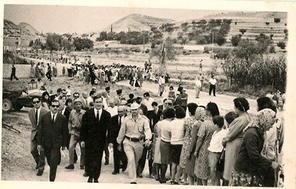
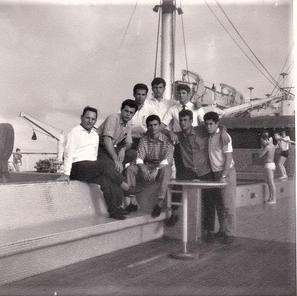
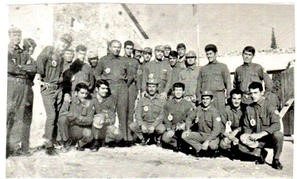
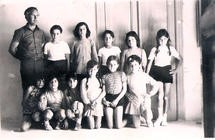
From the help of numerous individuals, we have been able to gather some pictures of both Lurucina and our ancestors. We hope you enjoy going through and if you have any pictures or videos that you would like to submit, please email … and we will add these on for you.
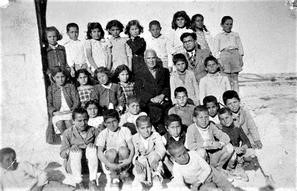
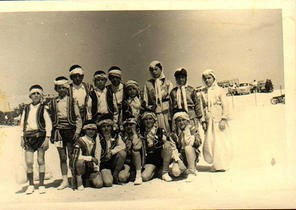
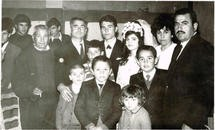
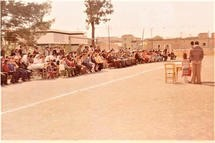
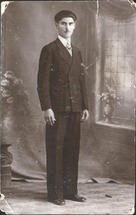
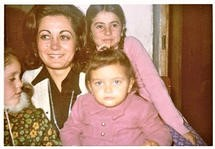
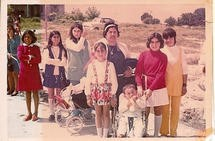
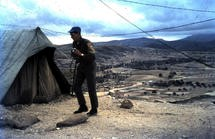
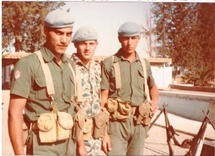
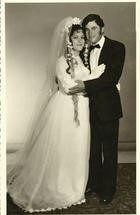
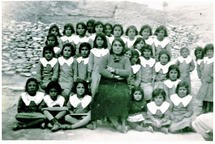
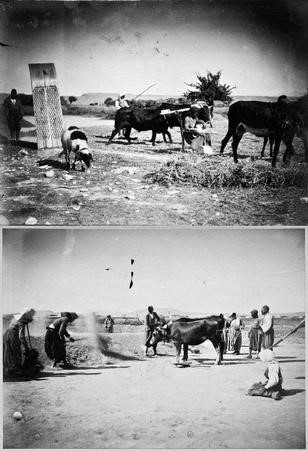
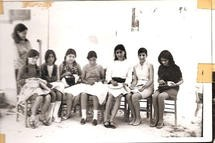
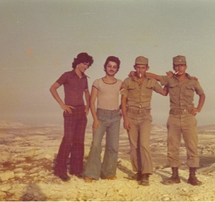
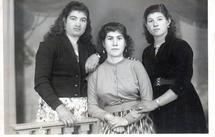
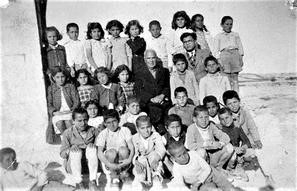
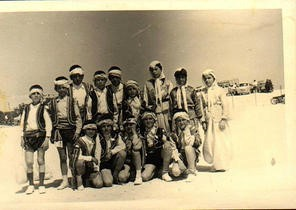
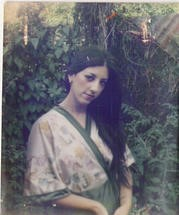
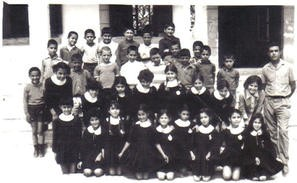
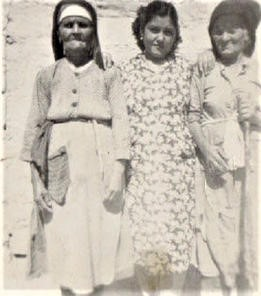
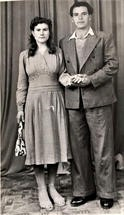
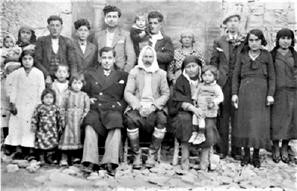
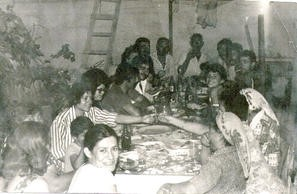
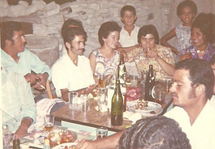
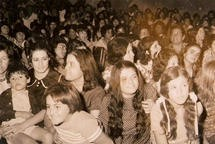
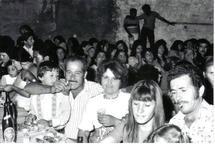
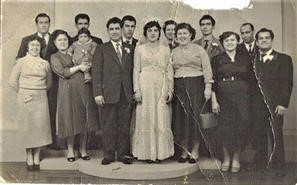
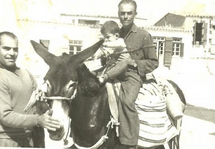
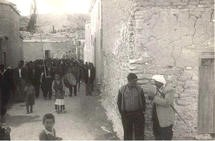
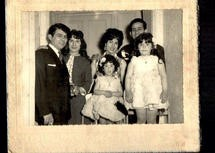
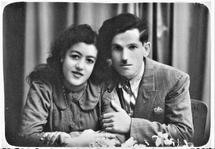
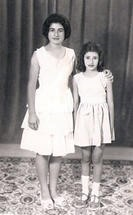
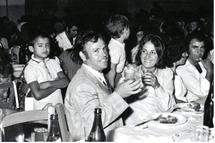
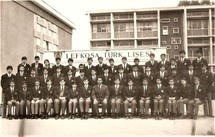
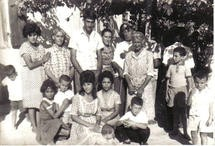
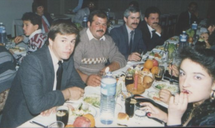
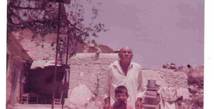
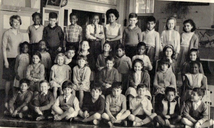
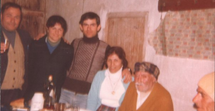
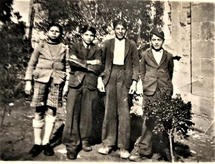
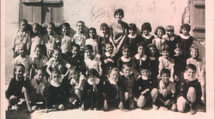
Fatma Yusuf ‘Galaba’, Mehmet Veli ‘Kirlapo. Children Melek, Ismail, ŞerminClassroom of Lurucina 1946Opening of the village hospital made possible by donations from the people of Lurucina, mostly from the diasporaCypriots on the ship migrating on from Cyprus1968. cigarette in hand Ahmet Sasetti 2/ Yusuf Yusuf Ku 3/Turhan Ahmet Sasetti 4/ Aysan Yusuf Yusuf Ku 4/Nebile Ibrahim Mavromadi 5/ Fikret Nasip Mirmikko. kids from left 1/Ertan Yusuf Yusuf Ku 2/Ersan Yusuf Yusuf Ku 3/Ibrahim Fikret Nasip 4/ Serife Fikret Nasip 5/Nasip Fikret NasipAkdogan. 23 Nisan Kutlamalari?İsmail Veli Erener ‘Çuffo’İbrahim Çufoğlu ‘Gorovgâli’2nd right Hansel Usta, 3rd right Salim Hoca, Sevgi HocanimMazlum Yusuf ‘Paşo’, Emine Emirali Oloyelo, Tangüner Mazlum “Paşo”, Tülin Mehmet ‘Çemberli’, Pembe Kara Hasansağdan Kemaliye, kızı Şengül, Şengül’ün arkasında başı görünen Siddiga Kelleci, Hanife, Hanife’nin arkasinda ? Mine Ağdıran, , Fatma Kelleci, Fatma’nın kızı, Tijen Ağdıran ve Fatmanın oğlu .2nd left Şermin Veli ( Şermin Paşa) at a Turkish dance display at Star Cross secondary Shool, North London. 1966-67?Lurucina from the Londra Gazetesifrom left, Zeki Aktuna, Fatma Hüseyin, Hatice Tahir, Veli Çufoğlu2nd left.Emine Debreli & Osman Yusuf Pire, Fatma Yusuf Phsillo/Galaba, kids front right Ismail & Melek Veli KirlapoAydın Karaöz ,Ali Batmaz , Aynur Karaöz , 1975Emine Mehmet Gatsura, Şermin (Şerife) Parıldak, Sevgi Burhan Parıldak, Canan Bada, (Canan Bilal Gökşan), Faize Rifat Gökşan, Hüseyin Rifat Gökşan, Cavidan Özerman, (Cavidan Bada) and Duygu Hasan Karaismail.A UN soldier of the Danish Contingent overlooking the countryside around the villageOrtadaki komandomuz İbrahim Süleyman ‘Yorgancı’Aydın and Veli Şekerali 1973Cavidan Veli (Cavidan Ali) 6th February 1977Cavidan Ali ( Cavidan Veli)The town of Dali could be seen behind the hills over the dirt track. Sheperds would often use this track as a short cut to the river near PyroiMehmet Kavaz in AfganistanHüseyin Hasan ‘Cangi’, Melek Beyzade, Hansel, ? and Aycan Hüssein.Emine & Ziliha Yusuf Phsillo/Galaba with Emine Debrelina in centreStanding Veli Çufoğlu seated from left Mustafa Gelener, Kerim Yücelen, Netice Mehmet, Zeki Aktunalate 1930’s or early 1940’s. Seated on the left is Ayse Yusuf ‘Galaba’ (wife of Yusuf Ucokka)Fatma Yusuf ‘Galaba’, Mehmet Veli ‘Kirlapo. Children Melek, Ismail, ŞerminLALA KARDEŞLER: Güner ve Osman Yusuf Lala (Fotoğraf: Artun Lurucinalı, Mart 2007, Londra)Benisev & Osman Kırıcı with Pembe & YusufATHIENOU PHOTOS OF1895 Top photo threshing on a packed-dirt threshing floor (Aloni) at Athienou in 1895. the bottom of a threshing sledge (Dhoukani) can be seen on the left, while two other sledges are in use on the right. One thresher is standing on the (Dhoukani) the other is sitting on a chair and breast-feeding her child;Minnie Mehmet (Emine Ibrahim Küçüki)Hüseyin Hassan Cangi and Nermin, (Çavuş Bili’s daughter)From right Emine Nasip, Fatma Yusuf ‘Phsillo’ & Alsev Nasip (Alsev Tari)Akıncılar Köyünde Dikiş Nakiş Kursu 1971. Sonay Hoca, Pembe İsmail Cano, Şermin Parıldak, Tomriz Murat Kertenkele, Sultan Muhtaroğlu, Duygu İbrahım Tuna, Işıl Mehmet and Meral Osman.Veli Çufoğlu, Ram Bekir, Hasan Gazi, and Veli Raif (Tekinalp)Ziliha, Dervişe Cangi and Nermin Hasan.Classroom of Lurucina 1946Tina KemranClass of 1971. Fatma Ali ‘Giccu’. Fatma Yusuf Phsillu'(Fatma Veli) & and Melek Ismail Kavaz ‘Yasena’ Personal archives of Ismail Veli ‘Kirlapo’The Kavaz family From 2nd left Osman & Benisev Kırıcı. Sidika with glass. Man on right is Behcet Ernaz.Personal archives of Ismail Veli ‘Kirlapo’Yusuf Osman Kırıcı ‘Gatsura with Yusuf Kırıcı . Standing Esat KartalVillage weddingNazemin-Süleyman & Osman Geleo (Gelener)Dudu Nafi, İsmail. İsmail, Fatma Heybeti, Ali ‘Tinti’ & Heybeti.Old man Arif Cebe with Arif and Hilmi GuşarIsmail Veli Kirlapo front 4th from left. Alfred Pritchard Junior School 1964From left. Veli Bekir Gaçari, Arzu & Veli Çufoğlu, Ayşe Veli Çuffo, Veli Bekir Gaçari, İbrahım Veli Çuffoİbrahım FarangaTurçi (Türk) familyRahme Parıldak.Derviş BiliMehmet Kavaz in BosniaAs described by Veli Çufoğlu1964-65 ders yılı ilkokul 2ve3 karma sınıfı öğretmenleri Taşkent Ramadan soldan sağa ön sıra Osman Mehmet,Mustafa Dalili,Hüseyin Gitsi,Hasan Hüseyin,Özen Mehmet,Emine Ahmet,Veli İbrahim(resmi facebooka koyan),Zeki Mehmet,Ayhan Kemal Olmalı emin değilim,Ramadan Rifat.Önden ikinci sıra İbrahim zeki olmalı(emin değilim),Öztürk İbrahim,Hasan İbrahim,Yusuf İbrahim Toz,Salih Rifat,İbrahim Süleyman,Raziye Mehmet olmalı emin değilim,? hatırlamam,Aydın İsmail,Şengül Skordo olmalı,Nadire,Ayşe Asım.Önden Üçüncü sıra Hüseyin (Fikriye abanın oğlu),? Hatırlayamadım,Sami,…Naim olabilir,Bekir Hüseyin,Veli Kemal,Fatma Hüseyin,Öğretmenimiz Taşkent Ramadan,Aysel Yusuf,Hatice..,Emine Seydali,Hilal Neşet olmalı,Zalihe (Fikriye abanın kızı).Arkadaşlar isimlerini bilemediklerimi hatırlıyorsanız duvarıma mesaj yazın yardım edin isileri tamamlayalımYusuf Ismail ‘Phsillo’ (Galaba) and Melek Yusuf ‘Phsillu’
A widely debated topic surrounding the people of Lurucina are the ancestorial roots. Some have made claims that they were Christian Greeks who converted to save tax, whilst others believe they were Venetians who converted to save themselves from discrimination from both Greeks and Turks. Additional claims suggested origins from Ottoman Turks. Despite all claims, there has been no historical evidence to back them up. The claims produced though sound plausible are often curated on wishful thinking, political ideology and sometimes prejudice.
The people of Lurucina in spite of identifying themselves as Turkish Cypriots by ethnicity, did also speak fluent Greek, which earned them a name Linobambaki (cotton wooleys) – this was used in a derogatory manner and simply implies they identified as Muslims to save tax or Christians to avoid National Service. Some historians made numerous references to the Linobambaki but they often went on what the general belief was, rather than make any effort to research each claim on its merits. Both Greek and Turkish Cypriots mocked and taunted the people of Lurucina in equal measure. It was derogatory insinuations that cemented a bond and determination to prevail and succeed in keeping the unique diverse culture on a positive footing. With a lack of research done, often never beyond the family trees, the history has been left to a few simple footnotes of passing phrases like “The Stronghold of the Linobamki” [1] and so on. There are other important centres of the island like Nicosia, Kyrenia, Famagusta etc, so to research a village which had been the target of ridicule from many sides of the ethnic makeup of Cyprus would have not been necessary.
After a 6 year intensive research based on orginal archive documents, a new perspective emerged. Firstly, the vast majority of ethnic Turks of the village did serve for years in the military, and using the 1831 and 1879 census documents, it is clear that nicknames were considered to reveal our past Latin or Greek origins and were common in family identification. In the 1831 census, only one or two nicknames exist on record; one is “Coban” (Shepard) and the other “Topal” (the lame) [2]. The vast majority of nicknames seems be among the last 4-5 generations with them decreasing in occurrence. On closer inspection there are some records of Muslim Turks marrying Christian women and converting to the Orthodox faith. In spite of the countless debates of conversions to Islam from the Christian faith, not a single person born between the period 1750 to present had been found to convert from Christianity to Islam. Considering there have been at least 8000 people recorded on the village family trees, it is an interesting claim to say the least.
Arguments suggest that if there were conversions, they took place immediately after the Ottoman Conquest of 1571 – though evidence to this theory has shown to be flimsy. In the first Ottoman census of 1572, there were 27 Cizye (Christian households) [4] but by 1643, this increased to 41 [5].
With a clear period of falling population count in Cyprus, how was there a 50% increase in the population of Luricina; The 1879 census which documents the population from 1796-1879, revels some details about the ethnic composition of the region. It identified individuals as Bosnian, Albanian and Arab. This suggests that these individuals likely had origins in these groups as it was unlike officials would register them without some basis of their heritage. Additionally, most family trees researched seem to begin around the 1750s to early 1800s, whilst the Orthodox Christian population shows a more consistent and continuous presence, with clear records from the 1572, 1643 and 1831 census. The 1700s were marked by turmoil and economic devastation, leading to a dramatic decrease in the island’s total population. The Christian population also declined during this period. However, the records indicate that the Muslim-Turkish element appeared more recently. By the 1831 census, there were 104 Muslim males across the 39 households, compared to 25 Christian males. This discovery highlights a significant demographic change, suggesting a more recent establishment of a Muslim population on the island, possibly linked to migration or other social factors.
Some of the largest family trees of our village namely the Arabic‘Kırlangıc’ (Şiliono), İbrahım Mustafa ‘Garaoli’, and Hasan Hüseyin Topal (or Çoban ) turned out to be Sipahi.[6] Sipahi refers to all freeborn Ottoman Turkish mounted troops and tribal horsemen in the Ottoman army. The word was used almost synonymously with cavalry. The Sipahis formed two distinct types of cavalry: feudal-like, provincial timarli and the paid regular Kapikulu Sipahi.[7] The Ottoman people had rights to the land but the Sipahi a unique kind of military aristocracy and cavalry portion of the military, also lived on the land with the farmers and collected tax revenues, usually, to subsidise the costs of training and equipping the small army, dedicated to serving the sultan. Many Muslim families settled in Lurucina around the same time. One possible reason is that local Christians or Latins joined a rebellion, and after it was put down, the Sultan rewarded loyal Sipahi cavalrymen with land. Historians might know more about these events, but they haven’t studied individual families in detail. To understand the role of the Sipahi, we can look at independent sources, as they were cavalry soldiers in the Ottoman Empire.
The following is from the Encyclopaedia Britannica.
“Sipahi, occasionally spelled spahi, was a feudal cavalryman of the Ottoman Empire whose status resembled that of the mediaeval European knight. The sipahi (from Persian for “cavalryman”) was holder of a fief (timar; Turkish: tımar) granted directly by the Ottoman sultan and was entitled to all of the income from it in return for military service. The peasants on the land were subsequently attached to the land and became serfs. The sipahis provided the bulk of the Ottoman army until about the mid-16th century. From then on they were gradually supplanted by the Janissaries, an elite corps composed of infantrymen paid regular salaries by the sultanate. In part, this change resulted from the increased use of firearms, which made cavalry less important, and from the need to maintain a regular standing army. The sipahis were completely discredited during the War of Greek independence (1821–32), and the timar system was officially abolished in 1831 by Sultan Mahmud II as part of his program to create a modern Western-style army.”
The Military Architecture describes them as Sipahi and was the Turkish equivalent of the European armoured knights. These troops were largely accustomed to fighting on horseback and their strength lay in their mobility as mounted archers. Their light weapons and armour were designed for hit-and-run tactics.
Since Kapikulu Sipahi were a cavalry regiment it was well known within the Ottoman military circles that they considered themselves a more superior stock of soldiers than Janissaries, who were sons of Christian peasants from the Balkans (Rumelia), and were basically slaves bound by various laws of the devşirme.
Whereas the Sipahi (both Tımarlı and Kapıkulu) were almost exclusively chosen amongst ethnic Turkic landowners, who made great strides of efforts to gain respect within the Ottoman Empire and their political reputation depended on the mistakes of the Janissary.
The information provided shows without doubt powerful evidence that the main families in Lurucina were from a strong ruling class of cavalry families stationed in Lurucina during a period of immense turmoil for the Ottomans, and most importantly, these families were from Turkic or Arabic Muslim background (the T.C Başbakanlık Osmanlı Arşivleri. Book TŞR.KB.d.00040. Pages 45 ve 46). In fact the 1833 land ownership (Başbakanlık Osmanlı arşivlerinin ML.VRD.TMT.d.16152 numaralı defterinin 49-52. Sayfaları. Luricina köyü. 1833 yılı. Prime ministerial Ottoman Archives Book number ML.VRD.TMT.d.16152. Pages 49-52.) also confirms that these wealthy families were large landowners. Many of these families each owned large tracts of land, for example, 3 members of the Ibrahim ‘Garaoli’ owned 289 donums of land plus many olive trees and animals and 3 members of The Mehmet Kadri family owned 239 donums plus an enormous number of animals and trees. Their status as Sipahi and high military positions were not easily won, but there is no doubt they were not rewarded for their services to the empire. We already knew the Mehmet Katri family were of powerful military stock. They were the largest land owners in Lurucina and the name ‘Kadri’ was not the real family name but was given to Mehmet Ismail ‘Kadri’ who belonged to the order of the Qadiriyyah, where it had originated from. More information about this family can be sought after in “The History of the Kavaz Family”.
The myth that the Muslims of Lurucina originally converted to reduce their tax burden seems to be completely discredited whilst the other myth they switched to Christianity when their national service came up seems to be as flimsy. Despite being believable stories, they do not have any hold beside any historic evidence or facts. The Ottoman records for the period 1786 to 1879 show an enormous number of men who completed their national service. [10] In addition most of the lakabs/Nicknames seem to belong to the generations born from the mid 1800’s to the period just before 1974.
In the past individuals have pointed out the fact that the people of Lurucina almost spoke exclusively in the Greek language as proof of their origins, but the main families and their status have shown they they belonged to the Muslim sect as recent as 1831. On closer inspection, the marriages between these families is further evidence that they inter-married due to their high class status. The marriage of Ayse Yusuf ‘Siliono’ with Mehmet Kavaz. (from the Kadri family), Serife Ibrahim ‘Garaoli’ with Hasan Yusuf ‘Arap’ are just two examples that families married due to status and large ownership of land. Depiste this, we all know that our grandparents, born in the late 1800s to these family groups, could hardly speak Turkish. They forgot their original language and switched to Greek. This phenomenon, more common than people think, is wrongfully used to justify the excuse that the people of Lurucina used to speak exclusively in Greek to prove their origins.
The Origins of the Katari Family and their Settlement
The name Katri originates from Qadiriyyah. The Qadiri Order is one of the oldest Sufi Orders and derives from the name, Abdul-Qadir Gilani (1077-1166), who was a native of the Iranian province of Mazandaran. The order is one of the most widespread of the Sufi orders in the Islamic world, and spread to Central Asia, Turkey, Cyprus, Balkans and much of East and West Africa. The Qadiriyyah have not developed any distinctive doctrines or teachings outside of mainstream Islam but believe in the fundamental principles of Islam, however, they interpret it through mystical experience. This name was normally given to certain individuals who followed the order of the Qadiriyyah. [1] What this implies for our ancestor Mehmet Katri/Kadri is not clear. What is clear however is that during the Ottoman period it was normal to use the name of the order one belonged to.
The origins of the Mehmet Katri family in Lurucina span at least 10 generations – Hasan Yucelen in his research found that Mehmet Katri was said to have come from Manisa Turkey, but settled in Dali and then eventually Lurucina [2]. Dates are hard to establish but Ismail Mehmet Kavaz, the son of Mehmet Katri, was born in 1791[3] so from these assumptions are made that Mehmet’s birth would be approximately 25-35 years previous.
In the mid 1700s, Cyprus was plagued by epidemics and regular swarms of loucsts which was followed by years of severe drought and the population decimated by death, pestilence and migration. The 1777 census showed the population at only 84,000 – although this may be unreliable, what is clear is the Cypriot population was in decline. With the Ottoman empire also in a decline, Cyprus was in dire straits, and army deserters roamed around the road from Nicosia to Larnaca, in order to rob and harass others as brigands. The village of Lurucina was smack in the middle of the two towns and the authorities needed a person of courage and experience to control the area – it was against this backdrop Mehmet Katri was offered large tracts of land in order to control, arrest and keep order.
Katari Family Land Ownership
The true extent of the land given is not certain but looking at the Ottoman census on the ownership of land amongst Mehmet Katri’s grandchildren, an indication of the extent to which this family were well rewarded for the service was given. This amounted to no less than 220 separately divided plots of land and the size varied depending on whether they were farm-land or living accommodation. The 1831 census of Muslim ownership land in Lurucina showed that the whole village owned land equivalent to 2210 donums of which 112 were vineyards [4]. With a total population of only 104 Muslims divided into no more than 6-8 family groups, it is most likely correct to assume a massage percentage was owned by the Katri family group. According to the 1879-82 census, only 4-5 family groups owned a few plots as opposed to many who just their tiny homes and farm plots.
For the state to have offered such large amounts of land for such a service, this meant Mehmet Katri had the experience and a reputation that the authorities were very much aware of. One of his doings was the construction of a small building as a post opposite the Phillidotissa Church near the main road; this also acted as a shelter when working the large tract of lands around the area. The building was still standing in 1882 as it was clearly identified (as Katrini) in Lord Kitchener’s map of Cyprus which he prepared soon after Britain took control in 1878. [5]
The Story of Yusuf Aga
Mehmet Katri had four sons and as the land was extensive and fertile they cultivated large tracts of vineyards, and other farm produce. It turned out that one of his sons Yusuf (Aga) was a bit independent and often argued with his father. The Ottomans were constantly recruiting men for the army and Mehmet offered his son Yusuf believing that it may help change his attitude. Sadly in those days army service could last many years and as it turned out Yusuf took after his father and went onto become a successful soldier. A courageous man handy with the sword and shield in hand-to-hand combat, became a bodyguard. He educated himself and earned the title of “Aga”. With no communication in those days and years having passed, the ageing Mehmet believing his son to be dead allocated the land to his remaining three sons, Kara-Mustafa ‘Hrisafi’, Veli and Ismail ‘Gacari’ and left some for himself. On his release Yusuf feeling aggrieved at his father’s actions decided to settle in Nicosia where he became a judge (Yargic). [6]
In those days it was customary to leave a basket of produce by the edge of the fields as a courtesy for passersby, but under no circumstances were they allowed to go and help themselves in the fields. One day Mehmet Katri spotted two men helping themselves to the grapes and becoming angry, arrested and handed them to the police. By a strange coincidence the thieves were brought before Judge Yusuf Aga, his son and realising that the case involved his father, passed an unusual sentence on the men. They were to be escorted by police to go before Mehmet Katri, get on their knees, kiss his hand and beg for forgiveness. Anticipating his father’s anger at such a light sentence he ordered the police that if Mehmet wished to challenge this sentence then he had the right to appeal in person to the Judge. As it turned out when the thieves in the presence of police carried out their sentence, Mehmet Katri became angry and asked the police “hangi deyus bu karari verdi”, (“what rascal has given this judgement”) . He immediately accepted the message given by the police from the judge and went to Nicosia with the policemen. Entering the court house he repeated his previous statement and came face to face and with his son and eventually started to embrace each other. After a long talk Mehmet persuaded Yusuf to come back to Lurucina where his share of the land was reinstated. Yusuf went on to have 5 children. Mehmet Can-Nuri, Veli ‘Kelle’, Bekir ‘Onbasi’, Yusuf ‘Aga’ (Bedasi) and Hacer who married Suleyman ‘Truho’.
Soon after Yusuf Aga settled back in Lurucina there was a wedding at Mehmet ‘Cemberli’s’ house. While the party was in full flow, a number of Albanian soldiers who were stationed nearby entered the house fully armed and demanded that the local strongmen had the right to sleep the night with the bride before the groom. This obviously caused massive concern and fear and someone suggested that they delay the proceedings in order to call Yusuf Aga for help in sorting out this unexpected intrusion. On receiving the news Yusuf dressed in full military uniform, with sword and shield in hand made his way to Cemberli’s house, standing on the front door, this unexpected sight alarmed the Albanian soldiers Yusuf lifting his sword smashed the oil light on the ceiling and advanced towards the Albanians. His advance convinced the so-called tough guys that they were up against an unusually fearless person and their next move was to run towards the nearest exit [7]. Judging by the issues in question this incident may have taken place in the 1820s. Strangely many Cypriots were often complaining about the arrogant and bullying methods of the Albanians who were based in Cyprus at the time and by the early 1830s most were replaced by Arabic (Mostly Egyptian) troops [8] who seem to have integrated much better into the gentler manner of the locals. There are a couple of family trees in Lurucina who originate from the Albanian and Bosnian people and this was confirmed in the Ottoman census of the period, and until recently everyone called them by their family nickname of ‘Arnauti’ and ‘Bosnak’s’.[9]
The Story of Mehmet Kavaz
The fourth son of Mehmet Katri was named Ismail Mehmet ‘Kacari’. and his son, Mehmet Ismail born in 1810 was to become the first person that earned the name Kavaz.(Guard). Fortunately, during a time when casualties in the Ottoman army were immensely high, he had survived and it was speculated that serving as a guard rather than in the front line was a major factor for this. That being said, to be given the title Kavaz, you must display courage and toughness.
Mehmet Kavaz married Ayse Yusuf ‘Siliono’ in 1839 and they had 5 sons & 2 daughters. This family originally settled in Pirga village before making a final move to Lurucina. In addition to inheriting large amounts of land from his father, Mehmet Kavaz must have earned a decent amount of wealth as he did in fact own a lot of land, and when his sons also returned from their service in the military, the amount of land owned by the family was enormous. Mehmet continued his civilian life as a Resber and also had a large number of animals which in the 1800s was a guaranteed source of wealth. Proof of this is that generations later, in spite of constant distribution of inherited land, there was still a substantial amount of land in the family. Ismail ‘Ismailo’, their first son was born in 1844 and he alone left tens of donums to his son Mehmet Ismail Kavaz ‘Ganu’ and according to the Descendants of Bekiro and Seido (Seyidali born in 1854) large amounts of land were owned by their relatives. The family homes were centred not far from the Mosque, between the stream and the Arabic ‘Siliono’ family, whilst their farmland was spread outside many parts of the village. The union of these 2 families must have been a big event because the Ottoman records show that between the 2 families, the plots of land amounted to 38 separate plots plus 80 sheep and goats, 2 cows, 3 donkeys and a mule for the Arabic family and 44 plots for the Mehmet Kavaz family plus 80 sheeps and goats, 2 cows, 3 donkeys. Together this amounted to no less than 82 separate plots of land. [10] An astronomical amount by the standards of the period.
Mehmet’s son Arif ‘Pasha’ married twice. His first wife died soon after having a son who was named Mehmet ‘Kaplan’ and his second wife was a Greek lady who was a devout Christian Orthodox. This was shown thorugh their children who were baptised and named Petros, Banayis, Yorgis and Athanasia. No doubt she must have had a great influence on her husband and for a man who served as a Kavaz with the title of Pasha, adopting such a drastic course would have created tremendous friction in the family. The family, except for Mehmet ‘Kaplan’ moved to Limassol and not much more is known about his baptised children.
Bekir Mehmet Kavaz
Bekir Mehmet Kavaz ‘Bekiro’ (another son of Mehmet Kavaz) was by most accounts a tough, well respected and devoted family man. On his return from the army he married the daughter of Mustafa Huseyin ‘Ushi’ and had two sons Mehmet ‘Bekiro’ and İsmail ‘Efendi’. Sadly, she died young and being a single parent in the 1880s-90s was no easy life. It was at this time that Pembe Mehmet ‘Gatsura’ also became a widow – her husband Rustem Hasan (son of Hasan Yusuf ‘Arap/Siliono’) also died young leaving her with two sons Mehmet ‘Birgo’ and Yusuf ‘Abeydo’. As the deceased Rustems aunt (Hala in Turkish) was also the mother of Bekir Kavaz then arranging the couple to be married was considered to be a great ‘sebab’, after all with four children between them they had a lot in common. It turned out to be a successful marriage and together they had another four children. Veli ‘Gutsoveli’, Serife, Katriye and the youngest born in 1908 Osman. By all accounts all the children grew up as one family. Ismail ‘Efendi’ became one of the first teachers in the village and features in a famous school photo taken in 1946 with his young students. The youngest Osman was a popular person at family weddings and supposedly had a great voice and was often encouraged to sing at all family gatherings.
The Ramadan’s Family Involvement in WW2
Seyit-Ali’s daughter, Keziban (1892-1955), married Mehmet Ramadan (May 11, 1886 – February 15, 1972). Mehmet joined the police force and moved to Larnaca around 1905. Together, they had eleven children. With the onset of World War II, Seyit-Ali and his twin grandsons, Hasan and Hussein, enlisted in the Cyprus Regiment. Mehmet Ramadan, who had become a corporal, had to relocate frequently due to his job as a policeman. Hasan and Hussein, Mehmet and Keziban’s twin sons, were born near Limassol in 1922, while their younger brother Seyit-Ali (named after his grandfather Seyit-Ali Kavaz) was born in Larnaca in 1925.
In 1939, World War II began, and by 1940-41, Nazi Germany had overrun Europe. The British Empire was fighting for survival. Turkish and Greek Cypriots rallied to the call of arms, with 20,000 Cypriots volunteering to fight for Britain. The twins were among the first to volunteer, but Seyit-Ali was too young and had to lie about his age to enlist. The Cyprus Regiment was formed, and Hasan was soon sent to defend the island of Crete against the experienced German paratroopers. Unfortunately, Hasan was captured along with other Cypriots.
Many served out the war as prisoners, but Hasan escaped and joined the partisans in Crete. His knowledge of the Greek language allowed him to pass as a local Greek civilian. He narrowly avoided capture a second time by escaping through the back of a house and fleeing to the mountains, where he continued to fight with the Resistance until the British Army liberated the island. Hasan then rejoined his unit in the 8th Army, better known as the Desert Rats, in North Africa. Meanwhile, his younger brother Seyit-Ali was also serving in the war.
Corporal Seyit Mehmed Ramadan, witnessed many historical moments during WW2 (i.e.: the bombing and destruction of Monte Cassino) and got into quite a few scraps. As an 18 year old, one night in March 1944 whilst on Guard Duty, he saved the life of his Platoon, whilst they slept. Apparently, he heard a noise in the distance and, shouted out for them to halt and identify themselves. When no response came, after the third time, he let out a shot. Everyone awoke and they went to investigate further, in the dark of the night, only to find a dead soldier. It turned out he was a German and Seyit killed him with a bullet to the forehead. He got very upset about killing a fellow human, but his Platoon Commander told him that it was a very good thing that he had done, because he had saved all their lives.
It was on 9 September 1944 when Hussein (one of the twin brothers) was leading a convoy in the mountains of Italy. As it had been raining the roads were narrow, slippery and treacherous and without any warning an American convoy suddenly came head on from around the bend. His motorbike skidded forcing him off and caused terrible injuries and he died. The official version was ‘battle accident’ and he was buried at the Ancona military cemetery where he still lies today. On his tombstone he is listed as ‘Corporal Hussein Mehmet, CY/1217’. [13] As for recognition, there is a letter from Prince Charles to Seyit, which acknowledges his contribution to WW2, but sadly has not been found. In addition he had other letters, from The Queen, Prince Phillip, Prime Ministers etc. This family’s sense of duty and honour seems to have seeped down through the generations and the younger generation are no doubt proud of their forefathers’ achievements.
Alper Mehmet
Another great achievement of any Luricinali was that of Alper Mehmet. Becoming an ambassador for the UK to Iceland in 2004. No doubt as an extended family the whole of our village felt the pride as in one’s son
Alp Mehmet (born Alper Mehmet) is a former British diplomat and one of the Alp Mehmet United Kingdom’s first two ethnic minority ambassadors.
Mehmet arrived in the United Kingdom from Cyprus in 1956 when he was aged eight and was educated at Parmiter’s Grammar School in East London, and at Bristol Polytechnic. Upon graduation from Bristol, he became an immigration officer (1970–79) and then an entry clearance officer in Lagos, Nigeria (1979–83). In 1983, he entered Her Majesty’s Diplomatic Service, serving in Romania, Germany and Iceland (twice) and leaving in 2008. When he was appointed as Ambassador to Iceland in 2004, he became one of the first two British ambassadors from ethnic minority backgrounds to be appointed. He now sits on the advisory council of Migration Watch UK.
The Legacy of the Katari Family
It’s clear from the above that the Mehmet Katri family was no ordinary family. The tradition of military toughness and courage has been passed down through generations. The latest being the son of Ayse & Tuncer Mehmet & grandson of Mehmet Seyit-Ali ‘Mono’, who by a strange coincidence carries his great granddad’s name Mehmet Kavaz. Mehmet served as a Colour Sergeant (a guard to the flag bearer). in the Royal Regiment of Fusiliers, an infantry regiment. Though it has no fixed ”home” i.e. the regimental headquarters is The Tower of London. Mehmet’s long career since 1989 has seen him serve in many parts of the world like Bosnia, Cyprus, Germany, Northern Ireland, Canada and the Falklands all during the 90’s and has served in Iraq and Afghanistan this century. He married Corrine in February of 2005 and they have two strapping sons named Adam and Jacob. It seems Mehmet’s desire to continue his proud career has not diminished. In fact he is now currently an Army Careers Advisor for the British Army. [16]
No doubt the spirit that brought Mehmet Katri and the Kavaz’s to Lurucina runs in the veins of the present day youth. So the sons of the Katri’s/Kavaz seem to be in many corners of the world. Taking their achievements and pride of their ancestors with them. In love or in tragedy one thing is certain, their gentle shadow still looms over the hills and valleys of Lurucina from whence they came.
References
[1] Wikipedia & Encyclopaedia Britannica
[2] Hasan Yucelen. Akincilar/Lurucina Turklerin Yuzyillik Varolus Mucadelesi page 29.
[3] Türkiye Cumhuriyeti Devlet Arşivleri Genel Müdürlüğü.1831-3 Osmanlı Nüfus Arşivleri . State National archives of The Republic of Turkey. 1831 Ottoman census Page 145.. “Osmanlı İdaresinde Kıbrıs, Nüfusu-Arazi dağılımı”
[4] Türkiye Cumhuriyeti Devlet Arşivleri Genel Müdürlüğü.1831-3 Osmanlı Nüfus Arşivleri . State National archives of The Republic of Turkey. 1831 Ottoman census Page 145. “Osmanlı İdaresinde Kıbrıs, Nüfusu-Arazi dağılımı”.
[5] Maps of Lord Kitchener. Section 10, drawn in 1882, and published in 1885.
This section details the village life of Lurucina and explains some customs that were crucial to the upbriging of our people.
Lurucina Turkish Youth Club
WW2, like the rest of the world, had effected many aspects of Cypriot life, but despite the harsh conditions, youngsters began to organise cultural, sporting and other social activities. With the ever-growing standards of education there was a desire to set up clubs with football matches in particular being very popular. The Lurucina youth sports club was set up in 1948 and became a focus point of sports activities for the younger generation of the period – this was supported by the whole village and many teachers and community leaders often attended the club which had been set up opposite the village mosque, built by Veli Usa. The aftermath of matches often saw large gatherings with food and drinks being a staple at such gatherings. This camaraderie often encouraged the youth to step up their energy in improving their standards.
Wedding Customs
Weddings were significant events in Cypriot culture – this was when the community was at its best and the whole village participated. The initial arrangements were often very important and delicate and until very recently, a strict code of conduct was adhered to. Couples’ wedding terms and arrangements were organised by the parents and the confidential and unofficial preliminary negotiations were conducted at the bride’s house but only after a formal meeting was set up by a family-friend or elder on behalf of the potential groom. If the prospective bride agreed to this match, the terms would be discussed. The Dowry was at the centre of this agreement and would consist of house linens, utensils and expenses for the wedding. In the old days, it was common for the engagement to last 2-3 years [1] and was customary to invite the whole village and the wedding would last a week starting on a Monday.
On the Monday, the bride and groom’s bed would be sown by the village women and would be accompanied by the violinists playing traditional music. Musicians at the weddings were never paid by the bride or groom’s family rather they were tipped by the relatives who had been called up to dance. Once the bed was completed to the sound of music, a young boy would be thrown on the bed and rolled over. Presumably so that the couple would have a healthy boy as their first baby.
On Wednesdays, the bride accompanied by many women and music would taken to the Hamam. The males would either meet up the groom’s house and would feast together. Religion played a major part in some customs but being a secular society alcohol had never been a problem – hence why despite being Muslim, Cypriots often indulged in wine and Zivania.
On Thursdays, the groom would have his last bachelor shave to the sound of music, folk songs and poems. The Bride’s home would see a hub of activity with the burning of henna, and no doubt sweet songs of praise. Friday was an important day, the bride and groom followed by a village procession would walk to the groom’s house. In front of the procession a man would be carrying a flag and another a bunch of Feslikan (Basil) flowers on his shoulders. Behind the flag and feslikan would be the bride and groom, and at a short distance behind followed by the men. It was considered to be very rude and disrespectful for the men to turn round and glance at the women who followed behind. On nearing the groom’s house a race among the youth would begin as to who would reach the house first with the person who won being rewarded a small pillow as a gift. Once the couple reached their home the procession would break up and the couple would begin their married life together.
The following morning the bride’s mother would bring soup to the newlyweds and request to see the quilt for confirmation of her daughter’s virginity. The breaking of the hymen and the blood on the quilt was considered to be proof of the female’s virginity. Sadly as we all know today the hymen could break from other circumstances such as sports, in fact some are born without it. The lack of blood would potentially break up the marriage and lead to massive gossip though this appeared to be very rare, as many young couples were much more enlightened than their parents. Historically speaking however it must have caused a great deal of recriminations and heart ache, especially if the poor female was innocent of any impropriety.
Agricultural Livestock
Lurucina, like most Cypriot villages, was blessed with fertile farming land. People often worked from sunrise to sunset and as a result of the hard working ethic of the villagers and its immensely productive soil, it helped Lurucina become what was by Cypriot standards of the day, a reasonably wealthy farming community. Its vineyards in particular were very fertile and the quality of its produce earned it the nickname ”Stafilyo-horio”, translated ‘Vine village’. Farmers would often gather their produce in the village centre ready to be collected by trucks from the city and wine producers would buy an immense amount of grapes, but these were also used to produce large amounts of good quality sucuk and kofter. Arguments among producers in those circumstances often turned out to be tense affairs, and the village mayor would often intervene to resolve situations. Due to the growing importance of its produce, agricultural and livestock fairs started in 1946 which had been greeted with enthusiasm. This event gave the producers a Dgreater incentive to produce goods at a higher level of quality and the farming Minister Mr McDonald accepted the invitation from Ali bey, the village Muhtar, and after listening to many requests decided that some were relevant to his position while other subjects were politely told that as the agricultural minister, they were not part of his departments sphere of concern.[3] The fair began in earnest and the results of the first fair were published in the village ‘Ates newspaper’ on October 20th. Lurucina won the Governor’s cup for the best organised farm fair therefore gave Lurucina a new sense of pride.
Schools and Education
When the British took over the administration of Cyprus in 1878, the island had such few schools where literacy levels were very low. Though no definite date is known, the first primary school in Lurucina is believed to have opened around the year 1900 [5]. However, this is not confirmed as no opening documentation has been found. The education and cultural Ministry’s documents do show however that by 1919-1920, a primary school for males was up and running with 53 pupils. The teacher at the time was Ismail Mehmet Efendi from the Kavaz family. The yearly wages earned by the teacher was 26 pounds. 20 was paid by Evkaf (trust) and the remaining 6 pounds were covered by the state. According to old timers every student that attended would make a gift to the teacher of eggs, bread or other types of food [6].
In 1915 the village Muhtar Yusuf Ali, with the support of Azalar Ahmet Osman, Arif İbrahım and Süleyman Arif presented a written request to Evkaf to support the opening of a girl school in the village. After five years of repeated lobbying, a girls school was finally opened in 1920 and a female teacher named Nahide Ahmet began in earnest and 42 girls attended. The first boys school was next to the village mosque, while the girls school was a bit further up the road near the village square. A few years later, south of the village, a mixed school was established on a high spot with a sizable playground. With the growing interest in educating their children, the school soon became full and the expanded building was unable to accommodate all the students. To satisfy the needs of a growing population a second primary school was opened on the road that led to the village of Limbia.
The determination of the village officials in lobbying the authorities to open a secondary school finally paid dividends and in 1951 the first secondary school in Lurucina was opened with enthusiasm. In addition to the students of the village other nearby villages like üçşehitler (Goşşi), Esendağ (Petrofan), Gaziler (Piroi), Dereliköy (Bodamya), Arpalık( Ay Sozomenos), and Dali began to attend with some travelling by bicycle. With much poverty, owning a bicycle was not always within families so many pupils had to walk the 2-4 miles to Lurucina. It was not uncommon for two children to ride on the same bike. Regardless of the weather, the desire to acquire a degree of education was so high that many children simply walked to and from their respective villages.
The first secondary school building was at Hüseyin Esmeroğlu’s house, but very soon as the classes grew to 3, permission was granted to begin classes in another building near to the mosque. This was a turning point in the village education and later on a much larger building was finally built. Many students from Lurucina and the surrounding villages who attended the secondary school eventually went on to higher education. Many became doctors, engineers, lawyers, teachers and many other professional trades. One of the most famous teachers who made a positive impact on the village education was no doubt Orhan Seyfi Ari. He went on to become a famous Cypriot poet earning him respect from all the ethnic communities on the island.
There were many problems during this period, school fees, ignorance, poverty and resistance to change all played their part. According to Orhan Ari’s memoirs he often went from house to house and even to the farming fields to encourage families to allow their children to attend school.[7] Some could not afford the school fees which in those days was common, and he started a collection fund to assist the poorer children to pay their fees. His dedication to his duty earned him so much respect that after their resettlement to Lisi/Akdogan in 1976 the people of Lurucina named a street after him in his honour.
It is important to bear in mind that the 1940’s and 1950’s were a male dominated society and sending females to higher education was resisted by some. This was eventually overcome to a great degree and many females from Lurucina went onto become professional’s in their chosen careers. Within a few years, the number of females entering secondary school from 30 to 60-70 and the village Muhtar (Mayor) Ali Rauf Efendi made great efforts to encourage locals to educate their children and raise the standards of the village to a higher level.
The Mosque and National Days
There was only one mosque in the village and its precise date of its original construction is not known, The Lord Kitchener maps of 1882 indicate a mosque in the exact spot of today’s one [8] but the present day building dates to the 20th century. The minaret itself was not built until 1930. The Muslim cemetery itself was built on the entrance to the village and it is believed that the cemetery was built by the first known muhtar of the village, Mehmet Bedasi. Once this became full, a new cemetery was built just to the east on the Dali road in 1967.
Most national and religious days were greeted with enthusiasm and after the customary visit to the mosque many would begin the celebrations. The wealthier families occasionally gave gifts to the poorer members of the community. Due to the poverty prevailing in the 1900’s the village like others also had their share of beggars. In 1948 Bekir Veli Demirci began the custom of firing a cannon shot to celebrate the end of the fasting on religious holidays. While preparing at his home for such an event in 1948 the powder exploded and he lost the use of his right arm. Despite this accident once recovering he continued his annual salutary shots until 1977.
With no cinema in the village the young made makeshift platforms to give performances and entertain the locals and it was in 1958 a cinema was opened by the Kavaz family of Veli Bekir Kavaz ‘Gutsoveli’ and his sons (now known as the Demirci family) [9]. They built a summer and a winter cinema and named it ”The Ulus Cinema”, after Ulus Ulfet who died in 1957 during the Cyprus emergency.[10] Another cinema was later built by Bekir Seyit Ali. Before the start of cinemas in Lurucina, people often made their way to a cinema 2-3 miles away in Dali run by Mr Vasos. However, with the growing affordability and expansion of television ownership, this led to cinemas losing their popularity.
Trades and Skills
During the 1930’s the level of professional skills among the people of the village was at a low ebb. With the advances in education and determination to better themselves many people began to learn new trades. By the 1950’s master builders, Footwear, clothing, carpentry, mechanics etc were growing in number, even in the music industry and theatre were a growing passion. Gülferi Süleyman went on to become one of the best known violinists in Cyprus. Osman Balikcioglu, though not actually born in the village, had roots in Lurucina, is one of the most popular actors on the theatre stage. Ramadan Gökşan was a well known Zurna player which is a popular instrument at Turkish weddings, and celebration of national events. His son Ismail Gökşan was another popular violinist, while his brother Rifat played the drums.[11] Veli Mustafa ‘Kirlapo’ was also a sought after drummer at village weddings.[12] Zeki Ernaz and a Kemal was so good that they nicknamed him after the instrument he played which was a sort of drum called a ‘Lauta’ or Oud in English which is similar to a lute. A Yusuf was also popular with the Darbuka (a goblet drum)
References
[1] Akıncılar (Lurucina) Türklerin Yüzyıllık Varoluş Mücadelesi By Hasan Yücelen ‘Mudaho’ pages 55-58
[2] Akıncılar (Lurucina) Türklerin Yüzyıllık Varoluş Mücadelesi By Hasan Yücelen ‘Mudaho’ pages 55-58
[3] Akıncılar (Lurucina) Türklerin Yüzyıllık Varoluş Mücadelesi By Hasan Yücelen ‘Mudaho’ pages 72-75
[4] Akıncılar (Lurucina) Türklerin Yüzyıllık Varoluş Mücadelesi By Hasan Yücelen ‘Mudaho’ pages 72-75
[5] Akıncılar (Lurucina) Türklerin Yüzyıllık Varoluş Mücadelesi By Hasan Yücelen ‘Mudaho’ pages 84-87
[6] Akıncılar (Lurucina) Türklerin Yüzyıllık Varoluş Mücadelesi By Hasan Yücelen ‘Mudaho’ pages 84-87
[7] Eren Ari (His son)in a personal correspondence & Akıncılar (Lurucina) Türklerin Yüzyıllık Varoluş Mücadelesi By Hasan Yücelen ‘Mudaho’ pages 84-87
[8] Maps of Lord Kitchener 1882, map No; 66. Enhancing the map on a computer shows this clearly.
[9] Akıncılar (Lurucina) Türklerin Yüzyıllık Varoluş Mücadelesi By Hasan Yücelen ‘Mudaho’ pages 87-89
[10] Şehit Ailelerı ve Malul Gaziler Derneği.
[11] Akıncılar (Lurucina) Türklerin Yüzyıllık Varoluş Mücadelesi By Hasan Yücelen ‘Mudaho’ pages 91-93